
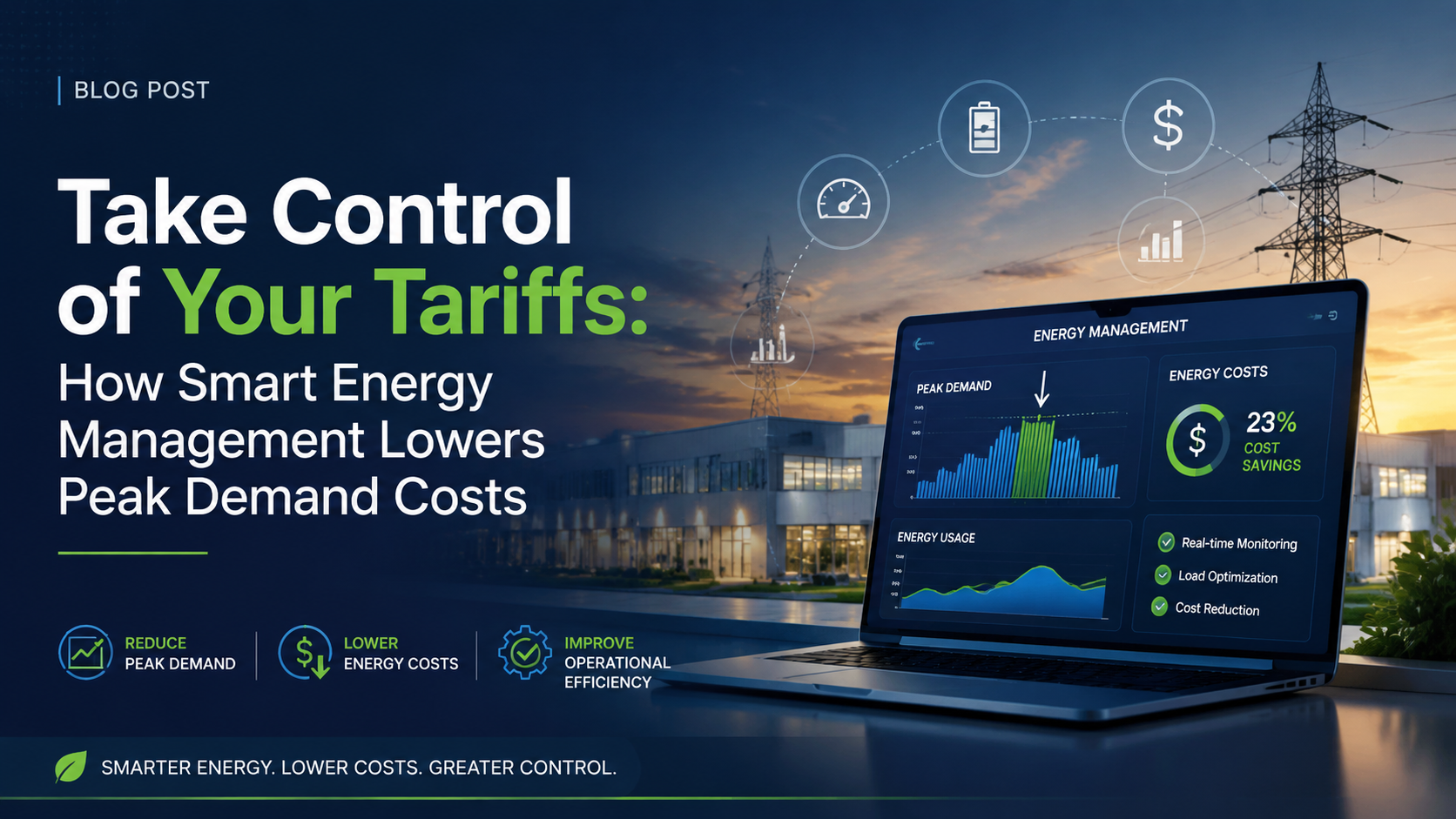
For commercial and industrial enterprise leaders, energy overhead remains one of the most volatile line items on the corporate balance sheet. While most management teams track total kilowatt-hour consumption, few address the single largest contributor to utility invoice inflation: maximum demand charges.
A single 15-to-30-minute surge in power draw during operational peak hours can set a facility’s demand tariff penalty for an entire billing cycle. Understanding how to control these cost triggers is essential for maintaining defensible EBITDA margins.
Deploying a structured smart energy management framework enables organizations to monitor, predict, and control load profiles in real time. This guide examines how active peak demand management transforms volatile electricity tariff structures into predictable business energy savings.
What Is Smart Energy Management?
Smart energy management is the integration of IoT telemetry, automated controls, and data analytics to optimize a facility’s power consumption profile in real time.
Unlike legacy manual energy audits, a modern energy management system (EMS) continually tracks power quality, active loads, and circuit-level draw across production lines and HVAC systems. It bridges operational technology (OT) with financial tariff planning to prevent uncoordinated equipment startups from exceeding pre-set maximum demand thresholds.
In practice, smart energy management shifts facility operations from reactive utility bill review to proactive load management, automated demand response, and automated peak shaving.
Why It Matters for Decision-Makers in Malaysia and Beyond

For business leaders managing manufacturing and commercial facilities in Malaysia and across global industrial markets, maximum demand charges can account for up to 30% to 50% of the total monthly electricity bill. Tariffs such as Tenaga Nasional Berhad’s (TNB) Medium/High Voltage Commercial and Industrial rates (e.g., Tariffs C1, C2, E1, E2, E3) heavily penalize peak kilowatt (kW) draw during designated peak hours.
The Strategic Impact of Demand Optimization
- Financial Yield: Moving from an unmanaged tariff profile—plagued by severe maximum demand charges and ICPT surcharges—to an optimized framework significantly lowers your baseline billing kW and locks in long-term utility cost reduction.
- Operational Control: Rather than allowing uncoordinated equipment startups to trigger sudden surge penalties, automated load staggering ensures smooth, power-consumption-optimized operations.
- Asset Health: Mitigating high electrical stress and excessive thermal load on machinery extends motor lifecycles and maintains optimal power factor correction across your facility.
Failing to actively control maximum demand charges leaves facilities exposed to volatile pass-through mechanisms and penalty surcharges. In continuous-production sectors, unmanaged electrical demand degrades operational efficiency and raises per-unit manufacturing costs.
Based on industry experience, facilities that implement systematic electricity tariff optimization protect their operational margins, achieve sustainable energy cost savings, and insulate operations against future grid rate adjustments.
Key Trends and Market Landscape
The market landscape for industrial energy management is evolving rapidly as utility grids decentralize and digital infrastructure matures. Over the next 12 to 36 months, three key drivers will dictate how industrial energy management and load management are executed:
- Real-Time Automated Load Shaving: Edge computing devices now trigger automated load shedding or battery discharge within milliseconds of reaching maximum demand limits, preventing human delay in tariff control.
- Integration of Battery Energy Storage Systems (BESS): Facilities are combining solar PV with battery energy storage systems (BESS) to execute peak shaving without altering core operational shifts or shutting down production equipment.
- Grid Demand Response Programs: Regulatory frameworks increasingly offer financial incentives to enterprise energy consumers who adjust power consumption during regional grid stress periods.
Common Challenges and Pain Points
Based on industry experience auditing heavy industrial and commercial sites, decision-makers face several recurring obstacles when attempting to reduce electricity costs:
- Uncoordinated Startup Sequences: Shift changes frequently involve simultaneous motor and chiller startups, generating massive, preventable demand spikes within minutes.
- Lack of Sub-Circuit Visibility: Standard utility meters provide aggregated monthly data, leaving engineers blind to which specific machines trigger peak demand penalties.
- Manual Monitoring Dependencies: Relying on facility operators to manually switch off non-essential loads during peak hours fails consistently due to human error or operational fires.
- Misalignment Between Plant Operations and Finance: Plant managers prioritize volume throughput, while finance teams suffer the billing consequences of unmanaged maximum demand charges.
- Power Quality and Harmonic Distortion: Poor power factors and uncorrected harmonics elevate apparent power (kVA) draw, driving unnecessary penalty surcharges on electricity bills.
Practical Solutions and Best Practices
Achieving long-term utility optimization and demand charge reduction requires an actionable, step-by-step strategy.
- Establish Continuous Energy Monitoring: Install sub-metering hardware across core distribution panels and high-draw equipment. Establishing a high-resolution baseline helps pinpoint exact peak demand triggers. For a closer look at audit methodologies, read our comprehensive facility utility management guide.
- Implement Automated Load Staggering: Re-sequence equipment startup schedules to eliminate coincident loads. Automated programmable logic controllers (PLCs) ensure that heavy compressors, pumps, and furnaces start sequentially rather than simultaneously.
- Deploy an Intelligent Energy Management System: Connect facility controls to an automated platform that continuously calculates rolling peak demand. Partnering with specialized engineering platforms—such as our industrial energy management solutions—allows organizations to automate load shedding of non-critical auxiliary systems during peak tariff windows.
- Review Tariff Classifications and Power Factor Metrics: Regularly evaluate facility load profiles against available utility tariff schedules. Maintaining a power factor above 0.85 or 0.90 (depending on utility regulations) eliminates low power factor penalties and reduces total kVA demand.
Future Outlook and Strategic Considerations
The transition toward digital energy infrastructure is no longer optional for energy-intensive enterprises. As regulatory bodies enforce stricter carbon reporting standards and utility providers adjust peak pricing structures, static energy management leaves companies at a structural financial disadvantage.
Based on industry experience, early adopters of automated tariff management and peak demand control achieve higher operational resilience and lower unit costs than industry peers. Developing internal capabilities and deploying real-time energy monitoring tools today ensures long-term cost stability.
Executive teams that treat energy as a manageable, controllable operational variable protect their bottom line while advancing sustainable operations.
Frequently Asked Questions (FAQ)
What is the difference between kWh charges and maximum demand charges?
Kilowatt-hour (kWh) charges measure total energy consumed over time, whereas maximum demand charges (kW or kVA) reflect the highest rate of energy consumption in a single short interval (typically 15 to 30 minutes) during the billing cycle.
How much can peak demand management reduce monthly electricity costs?
Depending on a facility’s load profile and industry, active peak demand reduction typically cuts total utility billing by 10% to 30%. Financial returns stem from lower maximum demand charges and the elimination of low power factor penalties.
Will automated peak shaving interrupt core production output?
No. Based on industry experience, smart energy management systems target non-critical auxiliary loads—such as HVAC setpoints, thermal storage, or secondary pumping—or utilize on-site battery storage. Core manufacturing processes remain unaffected.
How does smart energy management support corporate ESG goals?
Smart energy management optimizes power consumption, eliminates energy waste, and provides verifiable data for Scope 1 and Scope 2 emissions tracking. This auditable data simplifies compliance with international sustainability reporting frameworks.
Strategic Conclusion
Controlling peak demand costs through smart energy management is a direct, proven lever for operational cost reduction and profit margin defense. By replacing manual oversight with automated controls and real-time telemetry, leadership teams can transform unpredictable energy bills into a controlled, optimized operational expense.
To evaluate your facility’s peak load profile and explore targeted demand reduction strategies, contact our team of energy specialists to schedule an assessment.