
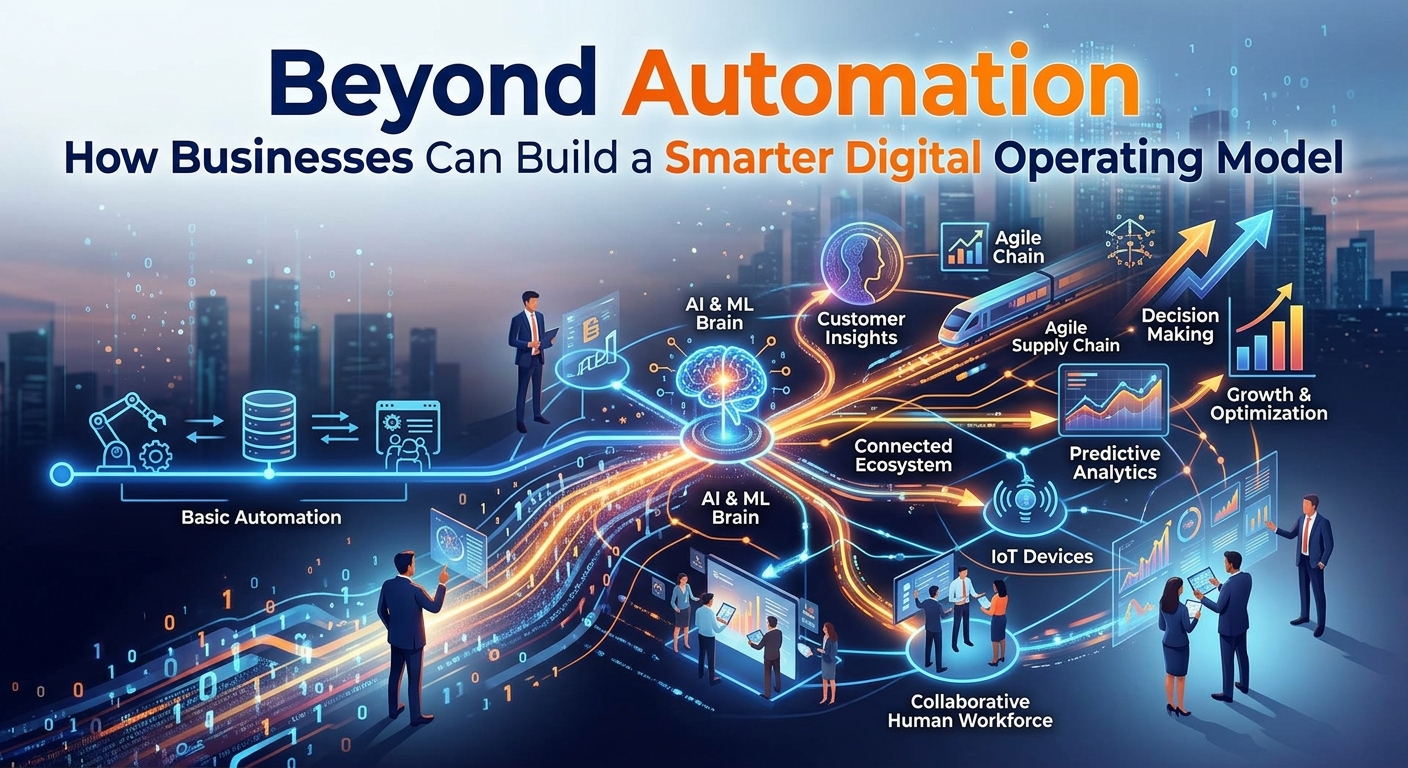
A digital operating model helps businesses move beyond basic automation by connecting technology, people, processes, data, governance and business strategy. While automation can reduce repetitive work and improve processing speed, it does not automatically fix inefficient workflows or fragmented systems.
For years, digital transformation was largely associated with automation. Businesses replaced manual data entry with software, introduced robotic process automation, digitized paperwork and developed dashboards to improve access to information. These initiatives delivered clear benefits by reducing repetitive work, improving processing speed and increasing operational visibility.
However, automation alone does not necessarily make an organization smarter. When an inefficient process is automated without first being redesigned, the organization may simply execute the same inefficient process faster. Unnecessary approvals, duplicated activities, fragmented systems and manual handoffs can remain embedded within the workflow even after new technology has been introduced.
This is why businesses are increasingly moving beyond task-based automation toward a broader digital operating model. Rather than treating digital transformation as a series of technology projects, businesses can use it to redesign how work is performed, how decisions are made and how value is delivered.
The objective is not simply to automate more activities. It is to create a business that can use technology and data more effectively to improve productivity, control costs, respond to customers and support long-term growth.
Why Automation Alone Isn’t Enough
Automation is an important part of digital transformation, but it is only one component of a broader operating model change.
Traditional automation generally focuses on individual activities. Software can automatically generate reports, transfer information between systems, send notifications, process documents or route approvals. These capabilities can reduce manual effort, but they do not necessarily address weaknesses in the underlying process.
For example, a procurement process may require several approval stages for relatively low-value purchases. Automating the approval notifications may reduce administrative work, but it does not eliminate unnecessary approvals. The organization may still have a lengthy procurement cycle despite having introduced automation.
A more effective transformation approach begins by examining the process itself. Unnecessary steps can be removed, responsibilities can be clarified, workflows can be standardized and decision rules can be simplified before automation is introduced.
This creates a fundamental distinction between automating a process and improving a process through technology.
Automation can deliver incremental efficiency. Process redesign supported by technology can create broader improvements in cost, speed, quality and scalability.
This distinction is becoming increasingly important as organizations invest in artificial intelligence, analytics, cloud platforms and intelligent automation. The greater availability of technology does not automatically create greater business value. Value depends on how effectively technology is integrated into the organization’s operating model.
From Task Automation to Outcome-Driven Systems
The next stage of digital transformation is moving beyond isolated automated tasks toward connected systems that support complete workflows and business decisions.
Instead of automating one activity at a time, organizations can connect data, applications, artificial intelligence, business rules and human decision-making across an entire value stream.
For example, a business can move beyond automating individual invoice-processing activities and redesign its entire procure-to-pay process. Supplier information, purchase orders, goods receipts, invoices, payment approvals and exception management can be integrated into a connected workflow.
AI can then be used to identify unusual transactions, highlight potential errors and prioritize exceptions for human review. Employees can focus their attention on activities that require judgment rather than spending large amounts of time on repetitive administrative work.
The objective is not to maximize the number of automated tasks. The objective is to improve the overall performance of the business process.
This means digital transformation should increasingly be evaluated through measurable outcomes such as:
- Lower operating costs
- Shorter processing times
- Higher employee productivity
- Fewer errors and defects
- Improved customer response
- Reduced equipment downtime
- Better resource utilization
- Improved decision-making
- Increased revenue or margin
This shift moves digital transformation from a technology deployment exercise toward a business performance initiative.
What Is a Digital Operating Model?
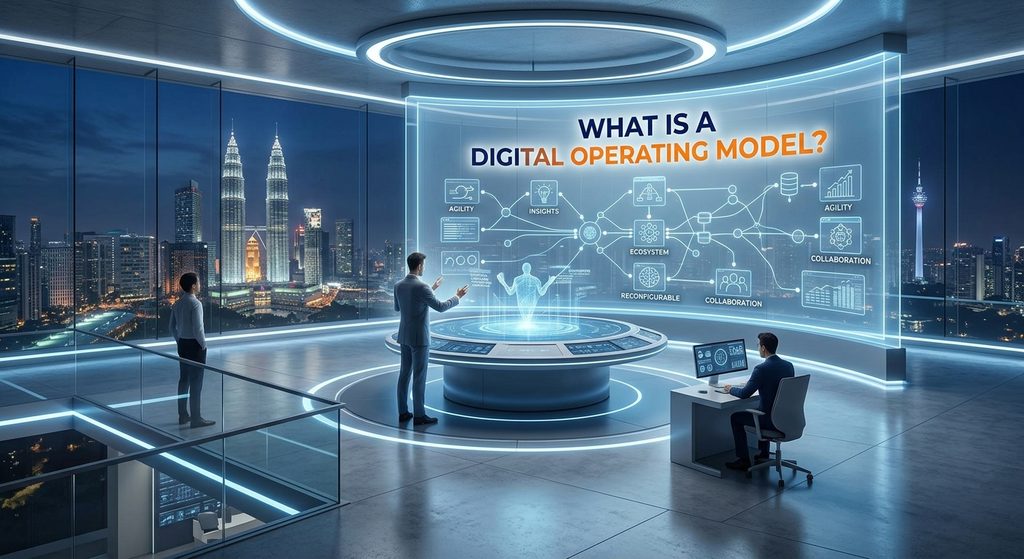
A digital operating model defines how an organization combines people, processes, technology, data and governance to deliver its business strategy.
It is broader than an IT architecture.
An IT architecture focuses primarily on how technology systems are structured and connected. A digital operating model considers how those systems are used across the organization and how they support employees, processes, decisions and business outcomes.
A well-designed digital operating model establishes clear relationships between:
- Business strategy
- Organizational structure
- Core processes
- Technology platforms
- Data and analytics
- Artificial intelligence
- Workforce capabilities
- Governance
- Performance measurement
This creates a bridge between business strategy and technology execution.
Instead of implementing technology independently within individual departments, organizations can design a connected operating model in which technology supports common business objectives.
For example, an organization seeking to improve customer service may need to combine CRM systems, customer data, workflow automation, analytics, employee training and performance management. Implementing a CRM platform alone would not create the desired outcome if customer information remains fragmented and employees continue using disconnected processes.
A digital operating model therefore considers the entire system rather than a single technology solution.
What a Smarter Digital Operating Model Looks Like
1. It Starts With Business Outcomes
A smarter digital operating model begins with clearly defined business outcomes.
Organizations should identify the areas where digital transformation can create measurable value. These may include reducing operating costs, increasing production capacity, improving service quality, reducing response times or strengthening customer retention.
Defining these outcomes early helps prevent digital transformation from becoming a collection of disconnected technology projects.
Each major initiative should have a clear relationship with the organization’s strategic objectives and performance indicators.
For example, an organization may establish a target to reduce order processing time by 30%. The technology investment can then be evaluated based on its contribution to that target rather than simply on whether the system has been successfully implemented.
This approach creates stronger accountability and makes technology investment easier to evaluate.
2. It Treats Transformation as an Operating Model Shift
Digital transformation affects much more than IT.
New technology can change how employees perform their roles, how departments collaborate, how information flows through the organization and how management makes decisions.
As a result, transformation requires involvement from business leadership, operations, finance, IT, human resources and other relevant functions.
IT teams play an important role in technology architecture, implementation, security and integration. However, business teams are responsible for understanding operational requirements and ensuring that new capabilities improve the way work is performed.
Cross-functional governance helps organizations manage these different requirements and maintain alignment between technology projects and business priorities.
3. It Simplifies Before It Automates
Process simplification should be a fundamental part of any digital transformation strategy.
Organizations should examine existing workflows for unnecessary steps, duplicated data entry, excessive approvals, manual handoffs and unclear ownership before introducing automation.
This is particularly important because technology can amplify both good and poor processes.
A streamlined process can become significantly more efficient through automation. A poorly designed process can become more complex when additional technology is layered onto it.
Process mapping, workflow analysis and standardization can therefore create the foundation for successful automation.
The sequence should generally be:
Assess → Simplify → Standardize → Digitize → Automate → Measure → Improve
This approach helps ensure that technology supports a better process rather than simply reproducing the old one digitally.
4. It Embeds AI Into Core Workflows
Artificial intelligence is becoming an increasingly important component of modern digital operating models.
However, AI initiatives often remain isolated within individual departments or pilot projects. While these experiments can demonstrate potential, they may not generate significant enterprise-wide value unless they are integrated into core workflows.
AI can support a wide range of operational activities.
In manufacturing, it can support predictive maintenance, demand forecasting and production planning.
In customer service, AI can assist with customer classification, response generation and issue prioritization.
In finance, AI can support forecasting, anomaly detection and financial analysis.
In supply chain management, AI can help identify risks, optimize inventory and improve planning.
The greatest value comes when these capabilities are integrated into processes and connected to measurable business outcomes.
AI should therefore be treated as part of the operating model rather than as a collection of independent technology experiments.
5. It Is Governed and Explainable
As AI becomes more deeply integrated into business operations, governance becomes increasingly important.
Organizations need clear policies governing where AI can be used, how data is handled, how models are monitored and who is accountable for decisions influenced by AI.
Human oversight remains important for decisions involving significant financial, operational, legal or customer consequences.
A mature digital operating model should incorporate:
- Data governance
- Model monitoring
- Access controls
- Risk management
- Performance testing
- Human oversight
- Accountability frameworks
Good governance does not need to prevent innovation. Instead, it provides the structure required to scale useful technology safely and consistently.
6. It Is Designed Around People
Technology changes the nature of work.
As automation and AI take over repetitive activities, employees may spend more time on analysis, exception management, customer interaction, problem-solving and higher-value decision-making.
This makes workforce readiness an essential part of digital operating model design.
Training should go beyond basic system usage. Employees need to understand how processes are changing, how technology supports their responsibilities and what new skills they need to develop.
Organizations may need to invest in:
- Reskilling
- Upskilling
- Change management
- Digital literacy
- Leadership development
- New role design
- Process ownership
- Performance management
The goal is to create a workforce that can work effectively alongside technology and contribute to continuous improvement.
7. It Is Designed to Adapt
Technology continues to evolve rapidly.
Artificial intelligence, cloud platforms, analytics, automation and connected technologies can change significantly within a relatively short period. A digital operating model therefore needs to accommodate future developments without requiring the organization to rebuild its entire technology environment.
Organizations can improve adaptability through modular processes, interoperable systems, strong data foundations and flexible technology architecture.
This allows new capabilities to be introduced more efficiently while reducing the risk of creating additional technology complexity.
An adaptable operating model can help organizations respond more effectively to changing customer expectations, market conditions and business requirements.
Digital Twins and the Convergence of Physical and Digital Operations
Digital operating models are also changing the relationship between physical and digital operations.
Digital twins are one example of this development. A digital twin creates a virtual representation of a physical asset, process or environment that can be used to monitor performance, simulate scenarios and evaluate potential changes.
For industrial organizations, digital twins can be used to represent machines, production lines or facilities.
This can support applications such as:
- Predictive maintenance
- Production optimization
- Capacity planning
- Energy management
- Equipment monitoring
- Scenario analysis
- Operational risk reduction
Instead of relying entirely on historical information, organizations can use real-time data and digital models to understand how operations may respond to different conditions.
The broader significance is that digital technology is moving beyond simple automation toward prediction, simulation and optimization.
This creates opportunities for organizations to make better decisions before changes are implemented in the physical environment.
Common Pitfalls to Avoid
Modernizing Systems Without Modernizing Processes
Replacing an outdated software platform with a newer system does not automatically improve business performance.
Organizations should redesign the workflows supported by the technology at the same time.
Measuring Technology Deployment Instead of Business Impact
The number of systems implemented, licenses purchased or processes automated does not demonstrate business value.
Digital transformation should ultimately be measured through operational and financial improvements.
Treating AI Governance as Optional
AI systems can introduce operational, data and compliance risks when they are deployed without appropriate controls.
Governance should therefore be incorporated into the design and implementation process rather than added after deployment.
Ignoring Workforce Readiness
Employees need time, training and support to adapt to new technologies and workflows.
Organizations that overlook workforce readiness may experience low adoption even when the underlying technology is effective.
Creating More Technology Complexity
Adding a new technology platform every time a business problem emerges can result in fragmented systems and higher maintenance costs.
A smarter operating model should simplify the technology landscape where possible and prioritize integration and interoperability.
Focusing on Technology Instead of Business Value
Digital transformation initiatives can lose direction when technology becomes the primary measure of progress.
Projects should remain connected to business objectives, measurable KPIs and expected financial or operational benefits.
How to Build a Smarter Digital Operating Model
Building a smarter digital operating model does not require an organization to transform every process simultaneously.
A focused, value-driven approach can help organizations prioritize the areas with the greatest potential impact.
Step 1: Define Three to Five Business Outcomes
Start with a limited number of measurable objectives.
Examples include:
- Reducing operating costs by 15%
- Improving customer response time by 30%
- Increasing production capacity by 10%
- Reducing equipment downtime by 20%
- Improving forecast accuracy by 15%
These objectives provide a clear foundation for transformation planning.
Step 2: Identify Priority Value Streams
Rather than examining individual departments in isolation, organizations should evaluate complete value streams.
Examples include:
- Order-to-cash
- Procure-to-pay
- Customer onboarding
- Production planning
- Service delivery
- Inventory management
- Maintenance management
Value-stream analysis helps identify problems that cross departmental boundaries and reveals where technology can create broader improvements.
Step 3: Map and Simplify Existing Processes
The current state should be documented before designing the future state.
Organizations should identify manual activities, duplicate work, unnecessary approvals, bottlenecks, system limitations, data handoffs and unclear responsibilities.
The future-state process should then be designed around the desired business outcome.
Step 4: Identify Where Technology Creates Value
Once the process has been redesigned, organizations can determine which technologies are appropriate.
Depending on the business requirement, potential solutions may include:
- Workflow automation
- Artificial intelligence
- Data analytics
- Internet of Things technologies
- Cloud platforms
- Digital twins
- Enterprise applications
- Intelligent document processing
Technology selection should follow the process and business requirement rather than determine them.
Step 5: Establish Baseline KPIs
Organizations should record current performance before implementing significant changes.
Relevant metrics may include cycle time, operating cost, quality, productivity, downtime, customer satisfaction, inventory levels or revenue.
This baseline provides the reference point required to evaluate future improvements.
Step 6: Pilot and Validate
A controlled pilot can help organizations test the technology, process design and adoption approach before scaling.
The pilot should have clearly defined performance measures and a documented business case.
Actual results can then be compared with expected benefits.
Step 7: Scale What Works
Successful initiatives can be expanded to other processes, departments or locations.
However, scaling should take account of differences in processes, customer requirements, operational conditions and technology environments.
The goal should be to replicate proven principles rather than blindly copy the same implementation everywhere.
Step 8: Continuously Improve
A digital operating model should evolve over time.
Organizations should regularly review technology performance, process efficiency, employee adoption and business outcomes.
Continuous improvement ensures that the operating model remains aligned with changing business conditions and technology capabilities.
Measuring the Performance of a Digital Operating Model
A smarter digital operating model should be measured across multiple dimensions.
| Performance Area | Example KPIs |
| Productivity | Output per employee, processing time |
| Cost | Cost per transaction, operating cost |
| Quality | Defect rate, error rate |
| Speed | Cycle time, response time |
| Reliability | Downtime, system availability |
| Customer | Satisfaction, retention, response time |
| Workforce | Adoption, training completion, productivity |
| Financial | ROI, payback period, margin improvement |
These metrics should not exist independently.
The strongest measurement frameworks connect technology adoption and operational performance to financial results.
For example, an AI forecasting system should not only be evaluated based on whether it has been deployed. Its performance should also be assessed through forecast accuracy, inventory requirements, stock availability and working capital.
Similarly, an automation platform should be evaluated through its effect on processing time, labor requirements, error rates and cost per transaction.
This creates a clear connection between technology investment and business performance.
The Future of the Digital Operating Model
The movement from automation toward intelligent operating models represents a broader change in how organizations think about work.
Traditional operating models often organize activities around departments, systems and individual tasks. A smarter digital operating model places greater emphasis on outcomes, value streams, data and continuous improvement.
Technology becomes an enabling layer across the organization rather than a collection of disconnected projects.
Automation handles repetitive activities. AI supports analysis and decision-making. Analytics provides greater visibility. Digital twins enable simulation and optimization. Employees focus more heavily on judgment, exception management, customer relationships and activities that require human expertise.
This combination can create an organization that is more responsive and adaptable.
The advantage does not come from having the most technology.
It comes from creating a stronger connection between strategy, processes, people, data and technology.
Organizations that establish this connection can improve their ability to respond to changing customer expectations, market conditions and operational requirements while creating a more sustainable foundation for growth.
Conclusion
Automation was never the finish line. It was the starting point for a broader transformation in how businesses operate.
Organizations that focus only on automating individual tasks may achieve incremental efficiency improvements while continuing to experience fragmented systems, inefficient workflows and disconnected decision-making.
A smarter digital operating model takes a broader approach. It aligns technology with business strategy, simplifies processes before automation, embeds AI into relevant workflows, strengthens data and governance, develops workforce capabilities and measures transformation through tangible business outcomes.
This approach changes digital transformation from a technology implementation exercise into a structured business performance initiative.
The future of digital transformation is therefore not simply about automating more work. It is about creating operating models that allow people, processes, data and technology to work together more effectively.
Businesses that make this shift can move beyond basic automation toward operations that are more intelligent, adaptable, efficient and performance-driven.
Ready to Build a Smarter Digital Operating Model?
Digital transformation creates the greatest value when technology, processes, people and business strategy are aligned.
If your organization is investing in automation, artificial intelligence or digital transformation but is not achieving the expected improvements in productivity, cost, quality or operational performance, a broader operating model review can help identify where value is being lost.
Our consulting team helps businesses assess processes, identify operational gaps, redesign workflows, align technology with business objectives and establish measurable performance indicators.
Contact us to explore how a smarter digital operating model can improve operational performance and support sustainable business growth.