
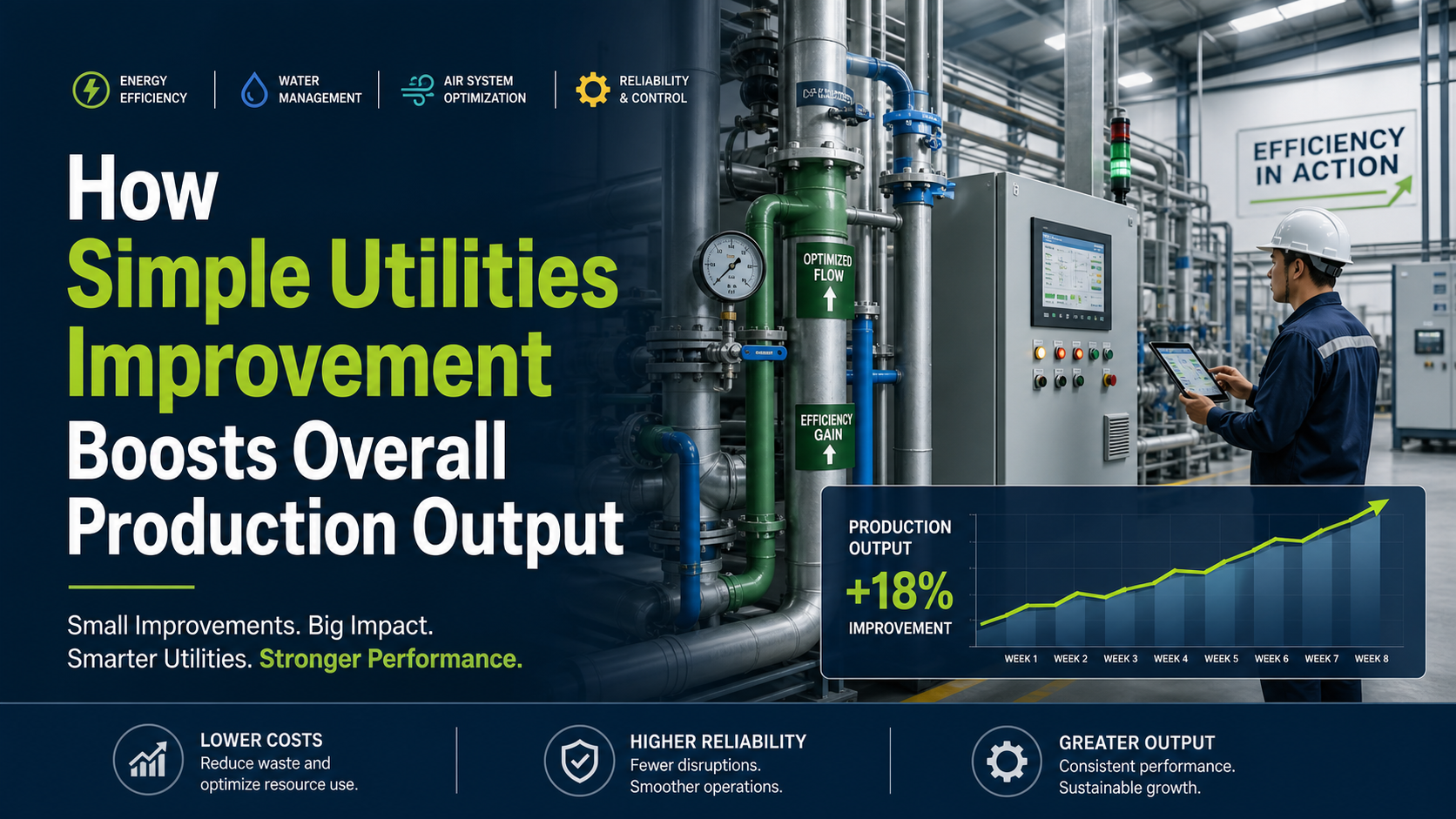
In high-throughput manufacturing and industrial operations, plant managers and operational leaders often look to assembly lines or direct machinery when production bottlenecks occur. However, unstable power quality, pressure drops in plant utilities, and unoptimized thermal management are frequently the root causes of unexpected downtime and reduced manufacturing productivity. Investing in utilities improvement helps eliminate these hidden bottlenecks while improving operational efficiency.
When facility inputs fluctuate, overall plant throughput and equipment lifespan take a direct hit. Systemic utilities improvement resolves these subtle friction points, yielding immediate gains in operational stability and output volume.
This article outlines how optimizing core facility inputs unlocks hidden capacity, strengthens facility resilience, and drives sustainable output gains for decision-makers evaluating strategic infrastructure investments.
What Is Utilities Improvement?
Utilities improvement is the targeted modernization, monitoring, and utility optimization of auxiliary plant systems—including electricity, compressed air, process steam, chilled water, and industrial gases—to improve manufacturing efficiency, maximize yield, and eliminate systemic waste.
Unlike basic energy conservation programs that focus solely on reducing overall consumption, utility optimization enhances line stability and output quality. It bridges electrical engineering, mechanical controls, and operational technology (OT) to align facility infrastructure with line demands.
In practice, simple adjustments like stabilizing pneumatic line pressure, tuning power factor correction, or deploying low-latency telemetry directly prevent equipment tripping and product defects.
Why It Matters for Decision-Makers in Malaysia and Beyond
For industrial operators and business leadership in Malaysia and global markets, utility overhead impacts both variable operating costs and total output metrics. Tariff adjustments—such as Imbalance Cost Pass-Through (ICPT) mechanisms—and peak demand surcharges can quickly erode profit margins.
| Impact Area | Operational Reality | Strategic Outcome |
| Manufacturing Productivity | Unstable input voltages cause micro-stoppages | High throughput consistency & reduced line scrap |
| Financial Yield | Peak-demand penalties increase per-unit cost | Substantial operational cost savings & margin defense |
| Asset Longevity | Thermal shocks and harmonic distortion wear motors | Extended equipment lifecycles & lower maintenance CapEx |
In regional manufacturing hubs where factories operate near continuous capacity, micro-stoppages caused by poor power quality or pressure drops can result in severe output losses. Addressing these root causes through energy-saving solutions turns volatile utility overhead into a predictable competitive edge.
Based on industry experience, facilities that stabilize auxiliary inputs achieve measurable gains in manufacturing cost reduction while mitigating risk across global supply chains.
Key Trends and Market Landscape
The global manufacturing landscape is moving toward integrated, intelligent facility management systems. Over the next 12 to 36 months, three primary shifts will dictate how industrial energy efficiency and plant utilities are managed:
- IoT-Driven Sub-Metering: Real-time sensor networks now track power quality, flow rates, and pressure drop across individual production lines, replacing reactive maintenance with predictive alerts.
- Grid Decentralization & Microgrids: Industrial sites are increasingly adopting solar PV arrays and battery energy storage systems (BESS) to smooth out voltage sags and lower peak demand costs.
- Mandatory Decarbonization & ESG Baselines: Global enterprise buyers increasingly mandate verifiable carbon footprints, making sustainable operations a strict commercial requirement for supplier contracts.
Common Challenges and Pain Points
From years of real-world plant audits, facilities repeatedly face core operational challenges that quietly degrade output:
- Hidden Micro-Stoppages: Hidden Micro-Stoppages caused by poor power quality, unstable plant utilities, and inefficient utility management silently reduce manufacturing productivity.
- Uncoordinated Startup Sequences: Simultaneous heavy motor starts trigger massive peak-demand spikes, leading to heavy utility surcharges.
- Leaking Auxiliary Distribution Lines: Undetected leaks in compressed air, steam, or chilled water loops require central plants to run harder than necessary, wasting energy and overloading assets.
- Siloed Facility & Production Data: Utility telemetry rarely integrates into overall equipment effectiveness (OEE) dashboards, leaving operations blind to utility-driven downtime.
- Reactive Maintenance Mindset: Operations teams focus on fixing broken line components rather than tuning the utility inputs that caused the failures.
Practical Solutions and Best Practices
Boosting manufacturing productivity through utility optimization does not require complete facility overhauls. A phased, practical approach delivers immediate returns.
- Conduct a Comprehensive Utility Line Audit: Identify immediate friction points by installing temporary sub-meters on high-draw machinery. Audit compressed air networks for pressure drops and examine power factor levels at main distribution boards. To review standard auditing frameworks, read our guide on industrial utility management strategies.
- Stabilize Auxiliary Input Pressures: Fixing distribution leaks and retrofitting variable speed drives (VSDs) on pumps and compressors ensures stable system pressure. This prevents pneumatic tooling from lagging and keeps robotic lines running at optimal speed.
- Implement Automated Load Balancing: Stagger startup sequences for heavy industrial machinery to eliminate peak demand penalties. Automated load-shaving systems smooth out consumption profiles, driving immediate business cost savings without lowering production quotas.
- Deploy Continuous Utility Management Platforms: Shift from periodic manual inspections to continuous telemetry monitoring. Leveraging dedicated platforms—such as our enterprise manufacturing productivity and utility solutions—enables real-time anomaly detection, optimizes energy efficiency, and protects core production lines from unexpected input variations.
Future Outlook and Strategic Considerations

The intersection of facility engineering and production management is becoming tighter. As industrial tariffs fluctuate and environmental compliance strictens globally, relying on legacy facility configurations creates compounding operational risks.
Based on industry experience, early movers who integrate real-time utility management into their primary operational technology stack outpace competitors in both cost efficiency and uptime. Preparing for future supply chain demands requires building internal telemetry capabilities today.
Leadership teams that treat utility optimization as a strategic growth driver secure both lower operating costs and higher production resilience over the long term.
Frequently Asked Questions (FAQ)
How does utilities improvement directly increase manufacturing output?
Optimizing utilities eliminates voltage sags, thermal fluctuations, and pressure drops that cause automated machinery to trip. Stabilizing these inputs reduces micro-stoppages, maintains consistent line speed, and increases overall throughput without requiring new production machinery.
What is the typical payback period for utility optimization projects?
Most targeted utility optimization projects achieve full payback within 12 to 24 months. Low-cost interventions, such as compressed air leak repair and load sequence optimization, often yield operational cost savings within weeks.
Can utility improvements be implemented without pausing production?
Yes. Based on industry experience, the majority of auditing, sensor installation, and telemetry deployments are non-intrusive and occur during normal operations. Equipment retrofits are scheduled during regular maintenance shut-downs to ensure zero lost production hours.
How does utility management assist with ESG compliance?
Utility management tracks and reduces Scope 1 and Scope 2 carbon emissions by lowering overall power, gas, and water consumption. Automated reporting systems generate auditable metrics that fulfill ESG disclosure standards and enterprise buyer requirements.
Strategic Conclusion
Utilities improvement is one of the highest-impact investments manufacturers can make to improve manufacturing productivity, reduce operating costs, enhance industrial energy efficiency, and strengthen long-term operational efficiency. By optimizing plant utilities and implementing proactive utility management, organizations can unlock hidden production capacity while improving equipment reliability and sustainability.
To evaluate your facility’s baseline load profile and identify immediate throughput opportunities, reach out to our engineering team for an operational assessment.