
Technology investment has become a strategic priority for organizations across almost every industry. Businesses are investing in cloud platforms, enterprise software, automation, analytics, artificial intelligence and connected systems with the expectation that these technologies will improve productivity, reduce costs and create new opportunities for growth.
Yet higher technology spending does not automatically translate into better business performance.
Many organizations continue to experience the same operational problems after implementing new systems. Employees may still rely on spreadsheets, managers may still wait for manual reports, production teams may still struggle with downtime, and decision-makers may still lack timely and reliable information. In some cases, organizations have multiple digital platforms but limited visibility across the business.
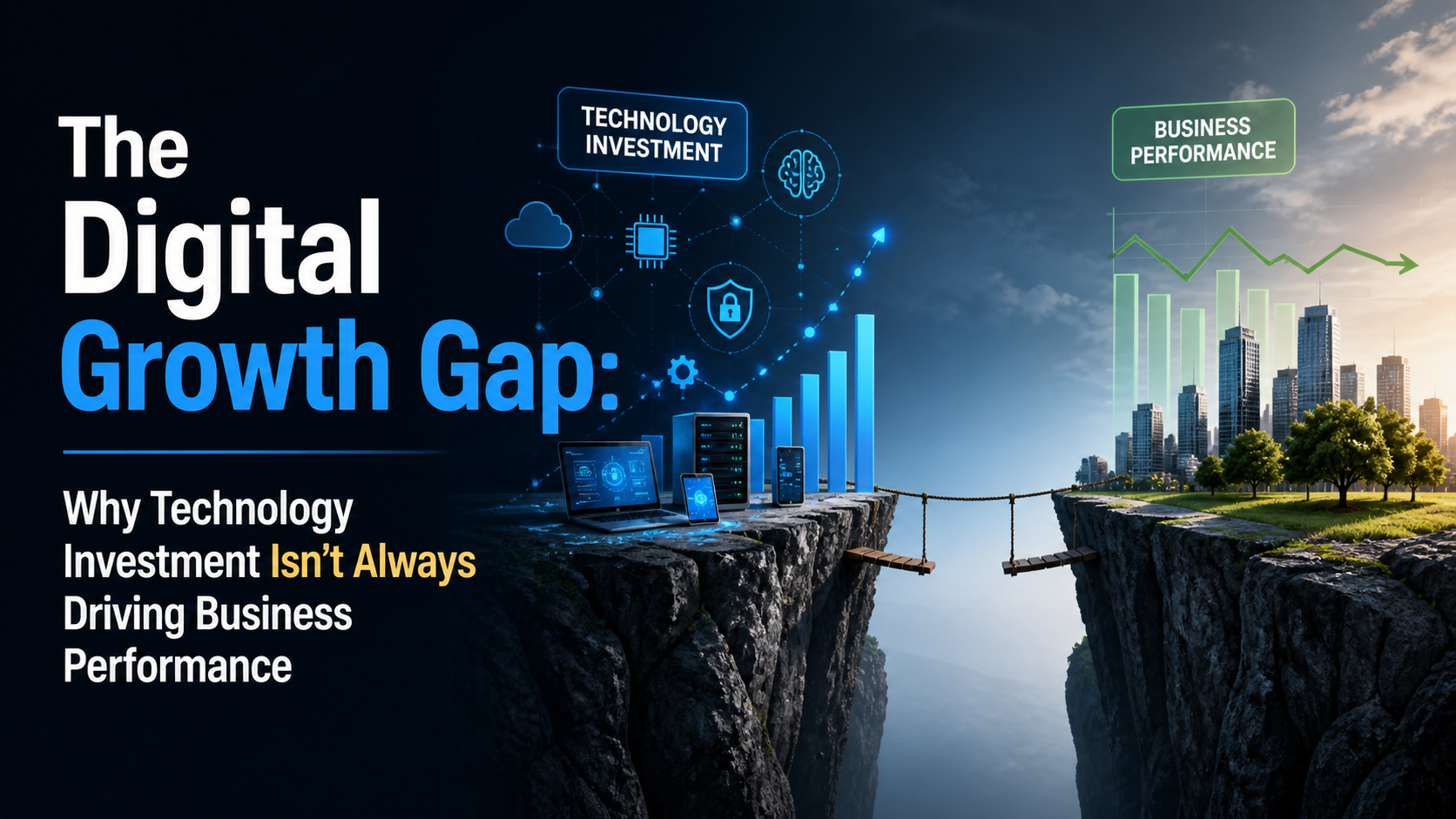
This disconnect between technology investment and measurable business outcomes is what can be described as the digital growth gap.
The issue is not necessarily that companies are investing in the wrong technologies. More often, the problem is that technology is being implemented without sufficient attention to process design, data quality, integration, employee adoption, governance and performance measurement.
As organizations continue increasing investment in digital transformation and artificial intelligence in 2026, closing this gap is becoming increasingly important. The businesses that create the greatest value from technology will not necessarily be those that spend the most. They will be the organizations that are best at converting technology investment into measurable operational and financial improvements.
What Is the Digital Growth Gap?
The digital growth gap describes the difference between the potential value created by technology investment and the actual business value an organization realizes from that investment.
The concept can appear in several ways.
A company may purchase an enterprise resource planning system but continue using spreadsheets because employees do not trust the new workflow. A manufacturer may install sensors and analytics software but fail to change maintenance processes based on the information being generated. A business may deploy artificial intelligence tools but struggle to move beyond experimentation because employees do not know where AI fits into their daily responsibilities.
In each case, the technology exists, but the expected business value does not fully materialize.
The digital growth gap therefore should not be viewed simply as a technology problem. It is a gap between technology capability and organizational execution.
Technology can provide faster access to information, automation, predictive insights and greater connectivity. However, those capabilities only create value when they are integrated into the way an organization operates.
A useful way to understand the relationship is:
Technology investment → Adoption → Process change → Operational improvement → Financial impact → Strategic value
If one of these links is weak, the return from the original investment can be significantly reduced.
The Data Behind the Gap
Recent research illustrates how widespread the challenge has become.
PwC’s 2026 Digital Trends in Operations Survey found that 89% of operations and supply chain leaders said their technology investments had not fully delivered the results they expected. Only 11% reported that their investments had fully delivered expected results. The survey also highlighted integration complexity, data quality and user adoption as important barriers to achieving technology value.
The findings are significant because they demonstrate that simply increasing technology investment does not guarantee better operational outcomes. Organizations may have access to sophisticated digital tools while still struggling to integrate systems, establish reliable data foundations and achieve meaningful adoption.
AI presents a similar challenge.
Kyndryl’s 2025 Readiness Report found that 62% of organizations had not progressed their AI initiatives beyond the experimentation or pilot stage. At the same time, 54% reported positive returns from their AI investments. This suggests that the challenge is not simply whether AI can create value. The bigger challenge is scaling successful applications across the organization and turning individual experiments into repeatable business outcomes.
These findings point toward an important distinction: digital transformation activity is not the same as digital transformation performance. An organization can launch multiple technology projects, increase its IT budget and deploy new digital platforms while still failing to achieve meaningful improvements in productivity, cost, quality or revenue.
The real measure of digital transformation is therefore not how much technology a company owns, but how effectively that technology improves business performance.
Why Technology Investment Doesn’t Always Translate to Business Performance
1. Technology Is Selected Before the Process Is Redesigned
One of the most common causes of poor technology ROI is selecting the technology before understanding the process that needs to improve. Organizations may purchase an automation platform because it promises faster processing, for example, without first examining why the existing process is slow. If the workflow contains unnecessary approvals, duplicated data entry or unclear responsibilities, automating the existing process may simply make an inefficient process run faster.
The same problem can occur with enterprise software. A new system may have sophisticated capabilities, but employees may continue using familiar spreadsheets, emails and manual workarounds because the underlying workflow has not been redesigned.
Effective digital transformation should therefore begin with the business process rather than the software. Organizations should first identify the current performance problem, understand the existing workflow, remove unnecessary activities and design the desired future-state process. Technology can then be selected based on its ability to support that improved process.
The question should not be, “What technology should we buy?” It should be, “What business problem are we trying to solve, and what technology can help us solve it?”
2. Integration Complexity Slows Down Transformation
Modern businesses rarely operate on a single technology platform. A typical organization may use an ERP system for finance and operations, a CRM platform for customer management, HR software, production systems, warehouse management tools, analytics platforms and various cloud applications.
When these systems do not communicate effectively, valuable information becomes fragmented. Employees may need to manually transfer information between systems. Managers may receive different versions of the same data. Reporting may require extensive spreadsheet work. IT teams may spend significant time maintaining connections between applications rather than improving business capabilities.
Integration problems can also increase the cost and duration of digital transformation projects. A technology solution that appears affordable during procurement can become considerably more expensive once integration, data migration, customization, cybersecurity and ongoing maintenance are included.
For this reason, integration should be evaluated as part of the original business case rather than treated as a technical issue after implementation. Before investing in a new platform, organizations should understand how the technology will interact with existing systems, databases, workflows and reporting structures.
3. Adoption Is Treated as an IT Problem
Successful implementation does not automatically mean successful adoption. A system can be technically operational while employees continue working around it. This happens when users do not understand the purpose of the new technology, when workflows become more complicated, when training is insufficient or when managers do not reinforce the expected changes in behavior. Technology adoption is therefore fundamentally a change management issue. Employees need to understand not only how to use a system but also why the organization is introducing it and how it will improve their work.
Business leaders also need to establish clear ownership and accountability. If a digital initiative belongs exclusively to the IT department, business teams may see it as an external system rather than a tool for improving their own performance. The strongest implementations involve business leaders, process owners, IT teams and end users from the beginning.
4. Poor Data Weakens Digital Performance
Technology is only as useful as the information it can access. Poor data quality can undermine even sophisticated digital systems. Duplicate records, inconsistent definitions, incomplete information and outdated databases can produce unreliable reports and inaccurate insights. This becomes particularly important when organizations introduce artificial intelligence and advanced analytics.
AI models and analytics platforms require reliable data to generate useful results. If the underlying information is incomplete or inconsistent, organizations may receive outputs that are technically sophisticated but operationally unreliable. This means that data governance should be considered part of digital transformation rather than a separate IT activity.
Organizations should establish clear ownership of critical data, standardize definitions, improve data quality and determine which information should be used for operational and strategic decisions.
5. Technology Impact Isn’t Measured Properly
One of the biggest reasons organizations struggle to demonstrate technology ROI is that they fail to establish a clear performance baseline before implementation. Consider a company that introduces automation and later reports that employees are “working faster.” Without a baseline, management cannot determine how much faster the process actually became.
A stronger approach would measure the original performance level. For example, if processing an order previously required 30 minutes, the organization could establish a target of reducing processing time to 15 minutes. If the new technology achieves that target while maintaining quality, the improvement becomes measurable.
The same principle can be applied to:
- Production cycle time
- Equipment downtime
- Energy consumption
- Inventory levels
- Defect rates
- Customer response time
- Forecast accuracy
- Cost per transaction
- Employee productivity
- Revenue per employee
The important point is that technology KPIs should ultimately connect to business KPIs.
System uptime, number of licenses activated and user logins can be useful indicators, but they do not necessarily prove that a technology investment has improved business performance.
6. Technology Is Evaluated on Purchase Price Rather Than Lifecycle Value
Another common problem is evaluating technology primarily according to its initial cost. A cheaper system may appear attractive during procurement, but it could require more manual work, additional integrations, frequent customization or significant maintenance over time.
A more expensive solution may create greater long-term value if it reduces operating costs, improves productivity, strengthens compliance and provides better scalability. Technology investment decisions should therefore consider the full lifecycle. This includes implementation costs, integration, training, maintenance, cybersecurity, upgrades, employee productivity, process efficiency and the financial value of the expected business benefits.
The right question is not simply “Which option costs less?” It is “Which option creates the strongest long-term business value relative to its total cost?”
Technology ROI Is an Operating Model Problem
One of the biggest misconceptions about digital transformation is that technology investment and business performance are directly connected. They are not.
Buying an ERP system does not automatically improve productivity. Implementing AI does not automatically reduce costs. Installing an analytics platform does not automatically improve decision-making. Technology creates the potential for improvement. The operating model determines whether that potential becomes measurable value.
For example, a manufacturer may invest in an advanced production monitoring system that provides real-time information about machine performance, downtime and production output. The technology may work exactly as intended, but if supervisors continue relying on manual reports and production teams do not act on the information, the organization may generate more data without achieving better performance.
This is why technology ROI should be evaluated through operational and financial outcomes rather than technology deployment alone.
A company should be able to connect a digital investment to measurable improvements such as reduced processing time, lower downtime, improved production throughput, fewer quality defects, lower inventory costs or increased revenue. This changes the way leadership should evaluate digital transformation.
Instead of asking: “Did we successfully implement the system?”
Leadership should ask: “What measurable business improvement did the system create?”
That distinction is fundamental to closing the digital growth gap.
How to Close the Digital Growth Gap
Closing the digital growth gap requires organizations to move from technology-led transformation to business-led digital transformation.
Start With the Business Problem
Every digital initiative should begin with a clearly defined business problem. Leadership teams should identify where the organization is losing productivity, capacity, revenue or cost efficiency before deciding whether technology is required. This prevents technology from becoming the solution in search of a problem.
Redesign Processes Before Automating Them
Organizations should map existing workflows and identify unnecessary steps, duplicated activities, manual handoffs and bottlenecks before implementing automation. A poor process that is automated can still produce poor results. Process improvement should therefore come before automation wherever possible.
Establish a Baseline Before Deployment
Organizations should document the current level of performance before implementing new technology.
For example, a company may record a current order processing time of 48 hours, a defect rate of 4.2% and equipment downtime of 12%. These measurements create a baseline against which future performance can be compared. Without a baseline, claims about technology ROI become difficult to validate.
Connect Digital KPIs to Business KPIs
Technology teams may track system availability, adoption rates and user activity. Business leaders need to track what those activities mean financially and operationally.
For example:
Technology KPI: 90% employee adoption
Business KPI: 20% reduction in processing time
Technology KPI: 95% system availability
Business KPI: 15% reduction in operational downtime
Technology KPI: AI forecasting model deployed
Business KPI: 10% improvement in forecast accuracy
This connection transforms digital transformation from an IT project into a measurable business improvement program.
Assign Clear Business Ownership
Every major technology initiative should have an accountable business owner.
IT teams are responsible for ensuring that the system works. Business owners are responsible for ensuring that the system is actually used to improve the process. This shared accountability helps prevent technology projects from becoming disconnected from operational objectives.
Plan Integration From the Beginning
Integration should be included in vendor evaluation, project planning and financial analysis from the beginning.
Organizations should assess existing systems, data flows, APIs, legacy infrastructure, cybersecurity requirements and future scalability before committing to a new platform. This reduces the risk of discovering major integration problems after implementation.
Measure Benefits After Implementation
Digital transformation should not end at go-live.
Organizations should conduct regular benefits reviews after implementation and compare actual performance against the original business case. A useful review cycle may include 30-day, 60-day, 90-day and six-month assessments.
If expected benefits have not materialized, management should determine whether the problem is related to technology, process design, data quality, employee adoption, capability or measurement. This allows organizations to correct underperforming initiatives instead of automatically investing in additional technology.
A Practical Framework for Measuring Technology Investment ROI
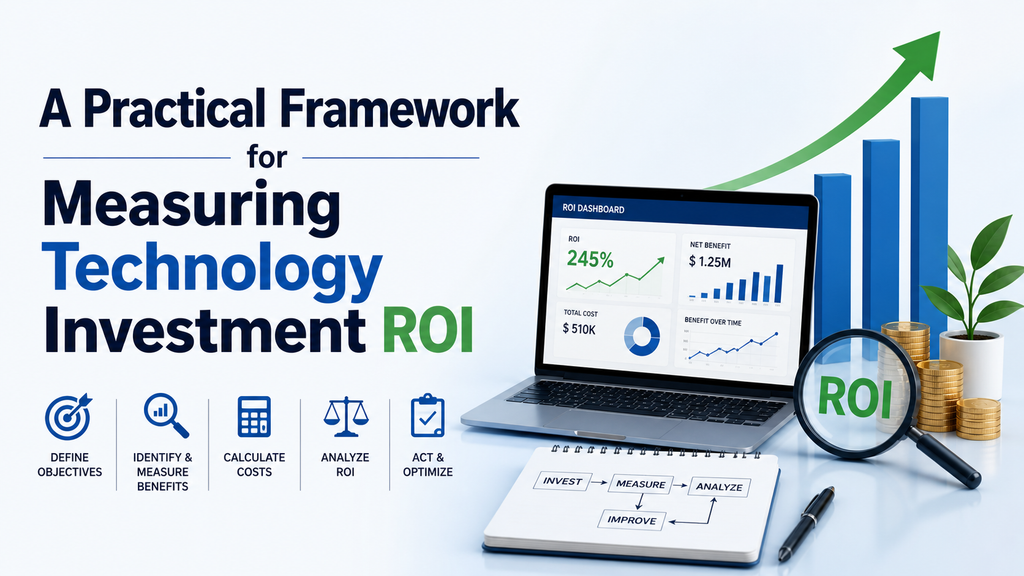
A strong technology ROI framework should connect investment to measurable business outcomes. The first step is to establish the investment baseline. This includes software, hardware, implementation, integration, training, maintenance and other relevant costs.
The second step is to establish the performance baseline. Organizations should measure the existing cost, time, quality, productivity or revenue associated with the process being improved.
The third step is to define the target outcome.
For example:
- Reduce processing time by 30%
- Reduce downtime by 20%
- Reduce operating costs by 15%
- Improve forecast accuracy by 10%
- Reduce defects by 25%
The fourth step is to measure actual performance after implementation. Finally, management should compare the financial value of the improvement with the total cost of the investment.
A simplified calculation can be expressed as:
Technology ROI = (Financial Benefits − Total Technology Investment) ÷ Total Technology Investment × 100
However, organizations should avoid relying on financial ROI alone.
Some technology investments may also create strategic value through better compliance, resilience, cybersecurity, scalability, customer experience or decision-making capability. A comprehensive evaluation should therefore consider both financial and strategic value.
KPIs That Connect Technology Investment to Business Performance
Different digital investments require different measures of success.
| Digital Investment | Operational KPI | Business/Financial KPI |
| Automation | Processing time | Cost per transaction |
| ERP | Order cycle time | Working capital |
| AI forecasting | Forecast accuracy | Inventory cost |
| CRM | Lead conversion | Revenue per customer |
| IoT | Equipment uptime | Downtime cost |
| Analytics | Decision-making time | Margin improvement |
| Warehouse technology | Picking accuracy | Cost per order |
| Quality software | Defect rate | Cost of poor quality |
The purpose of this framework is not to create more reporting. It is to make sure that every major technology investment has a clear connection to the organization’s strategic and operational objectives.
The Role of Process Improvement in Digital Transformation
Technology and process improvement should not be treated as separate initiatives. In many organizations, digital transformation fails because technology is implemented without changing the underlying process. As a result, companies may digitize inefficient workflows instead of redesigning them.
Process improvement provides the bridge between technology capability and business performance. By identifying bottlenecks, removing unnecessary activities, standardizing workflows and clarifying responsibilities, organizations can create processes that are ready for automation and digital optimization. Technology can then amplify those improvements.
This creates a more sustainable transformation model:
Assess → Redesign → Digitize → Automate → Measure → Improve
The process is continuous rather than a one-time technology implementation. As business requirements change, organizations must continue reviewing their processes, data, systems and performance metrics to ensure that technology remains aligned with business objectives.
What Leaders Should Ask Before Approving Another Technology Investment
Before approving a major technology initiative, senior management should ask several fundamental questions.
What business problem are we solving?
If the problem cannot be clearly defined, the technology investment may not have a sufficiently strong business case.
What process will change?
Technology should create a meaningful change in how work is performed rather than simply adding another digital layer to an existing workflow.
How will success be measured?
Management should identify specific operational and financial KPIs before implementation.
Who owns the business outcome?
A technology project needs an accountable business owner who is responsible for realizing the expected benefits.
How will the new system integrate with existing technology?
Integration, data quality and interoperability should be assessed before the investment is approved.
What happens if adoption is lower than expected?
Organizations should have a change management and adoption strategy rather than assuming that employees will automatically embrace the new system.
When will we know whether the investment worked?
The business case should include specific milestones for measuring benefits after implementation.
These questions help shift technology investment discussions away from features and toward measurable business value.
Conclusion
The digital growth gap is not fundamentally a technology problem. It is a business performance problem.
Organizations can invest heavily in AI, automation, cloud platforms, analytics and enterprise software and still see limited returns if those investments are disconnected from the way work is actually performed.
The evidence increasingly points in the same direction. PwC’s 2026 Digital Trends in Operations Survey found that 89% of operations and supply chain leaders said their technology investments had not fully delivered expected results. Kyndryl’s 2025 research similarly found that 62% of organizations had not progressed their AI initiatives beyond the experimentation or pilot stage, despite more than half reporting positive AI returns.
For leadership teams, the lesson is straightforward: technology should follow business strategy, not replace it.
The organizations most likely to close the digital growth gap will be those that redesign processes before automating them, establish measurable performance baselines, strengthen data and integration, drive employee adoption and continuously connect technology investment to financial and operational outcomes.
The goal of digital transformation is not simply to become more digital. It is to become more productive, more efficient, more responsive and more profitable because digital technology is being used effectively. That is where technology investment becomes business performance.
Ready to Close Your Digital Growth Gap?
Technology investment should create measurable business value—not simply add another system to your organization. If your business is investing in digital transformation, automation, AI or new technology but is not seeing the expected improvements in productivity, cost, efficiency or performance, it may be time to look beyond the technology itself.
Our consulting team helps organizations identify performance gaps, improve processes, align technology with business objectives and establish measurable KPIs that connect digital investment to real business outcomes.
Let’s turn technology investment into measurable business performance.
Contact us today to discuss your digital transformation and performance improvement goals.