
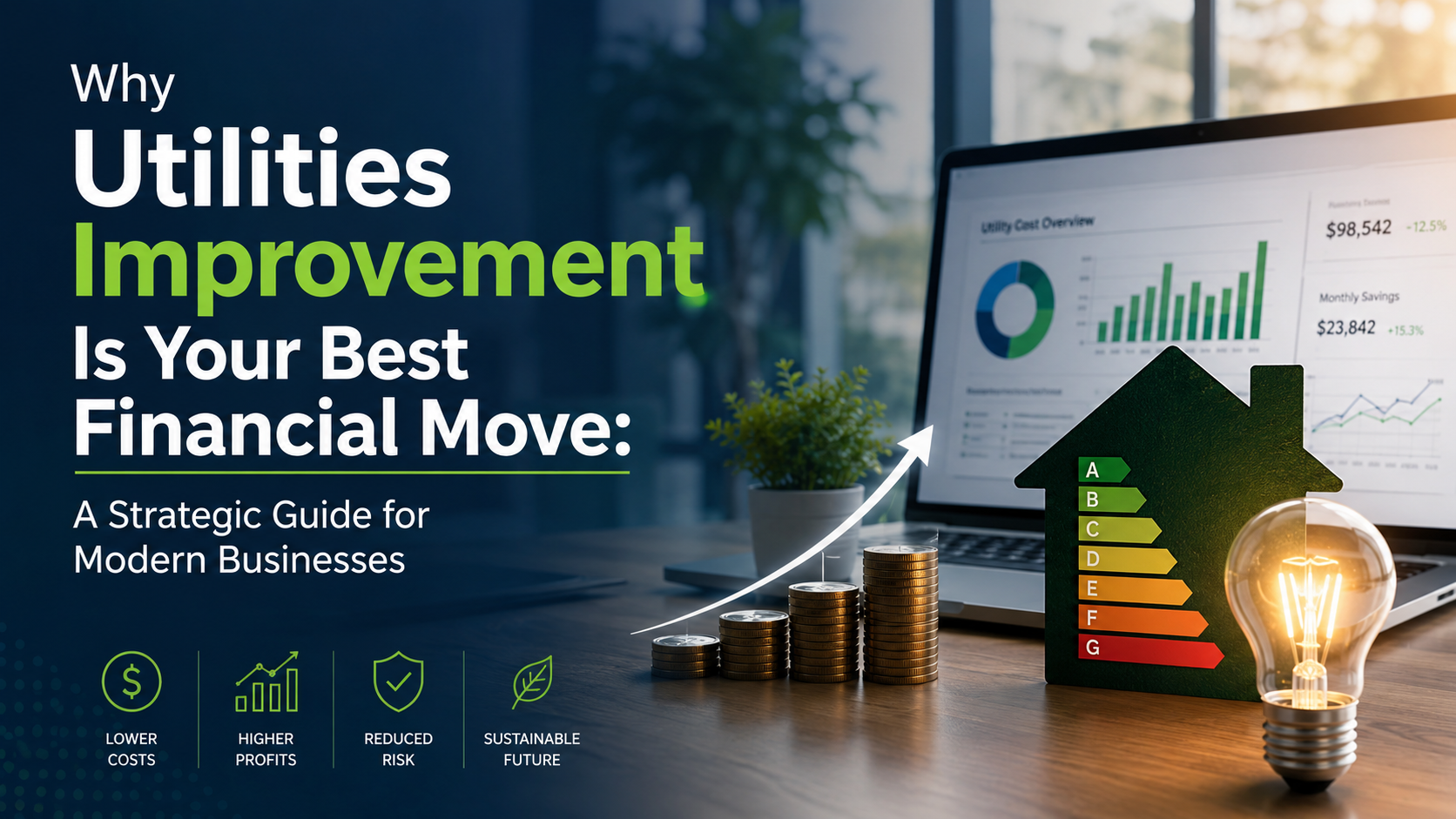
Rising operational expenses, shifting energy tariffs, and strict sustainability mandates are squeezing profit margins across commercial and industrial sectors. For senior executives seeking defensible margin expansion, traditional cost-cutting measures like headcount reduction or marketing budget cuts often carry significant strategic downside.
Strategic utilities improvement presents a high-yield alternative, transforming necessary operational overhead into a predictable driver of financial performance. By optimizing power, water, gas, and thermal systems, organizations can unlock immediate capital while future-proofing operations against market volatility.
This guide outlines the strategic logic, operational frameworks, and measurable benefits of utility optimization for forward-looking leadership teams.
What Is Utilities Improvement?
Utilities improvement is the systematic analysis, modernizing, and management of core facility inputs—including electricity, natural gas, water, steam, and compressed air—to maximize operational yield and minimize waste.
Unlike basic conservation efforts that rely on passive behavior changes, utility optimization integrates advanced engineering, real-time telemetry, equipment retrofits, and tariff restructuring. It operates at the intersection of energy management, facility engineering, and corporate financial planning.
In practice, a modern program combines hardware upgrades, automated controls, and ongoing performance monitoring. This dual focus ensures that baseline operational cost savings are captured immediately and sustained over long asset lifecycles.
Why It Matters for Decision-Makers in Malaysia and Beyond
For business leaders managing operations in Malaysia and expanding across global markets, utility expenditures represent one of the largest controllable variable costs on the income statement. Fluctuating fuel pass-through mechanisms, adjusting tariff structures (such as ICPT adjustments), and evolving carbon compliance expectations directly impact EBITDA.
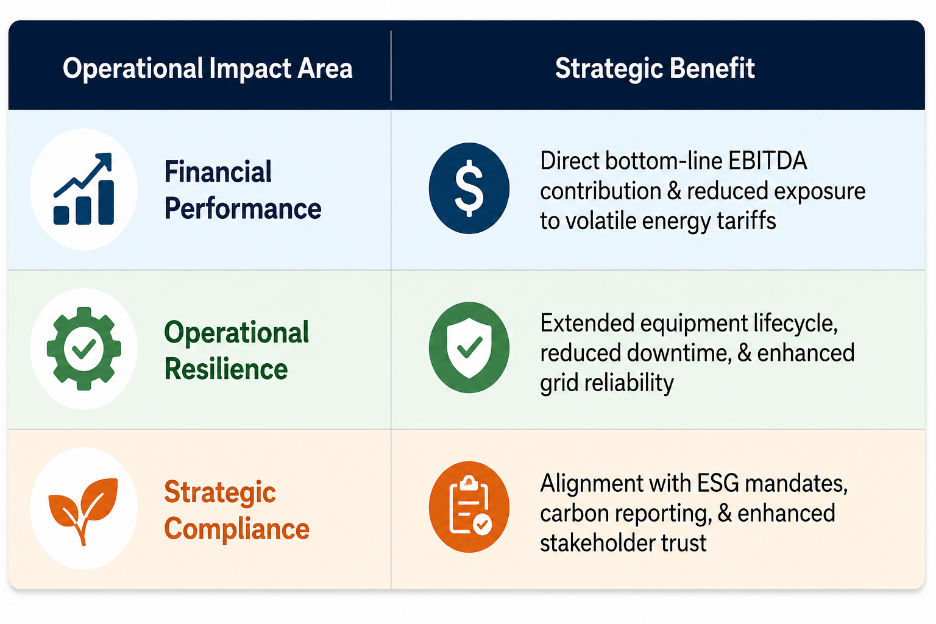
Failing to modernize utility infrastructure exposes facilities to significant operational and financial risks. In high-density manufacturing and commercial hubs, power quality issues, thermal inefficiencies, and unoptimized peak-demand usage led to unnecessary surcharges and premature equipment failure.
Organizations that proactively implement energy-saving solutions protect their supply chain resilience while achieving significant business cost savings. Controlling utility inputs converts unpredictable market variables into baseline competitive advantages.
Key Trends and Market Landscape
The global landscape for enterprise utility management is shifting rapidly toward data-driven, decentralized energy architecture. Over the next 12 to 36 months, three structural drivers will redefine how industrial energy efficiency and commercial utility systems are managed:
- Data Granularity via IoT and Edge Analytics: High-resolution metering now enables real-time visibility down to individual sub-circuits and heavy machinery, replacing delayed monthly utility invoices with actionable operational insights.
- Electrification and On-Site Generation: Facilities are increasingly integrating solar PV, battery energy storage systems (BESS), and microgrids to mitigate grid volatility and reduce peak tariff rates.
- Decarbonization Mandates and ESG Reporting: Financial institutions and enterprise supply chains now require verifiable emissions tracking, making sustainable operations a core requirement for securing capital and client contracts.
Common Challenges and Pain Points
Based on industry experience auditing large-scale commercial and industrial facilities, organizations frequently face structural hurdles when attempting to reduce utility costs:
- Siloed Facility Data: Energy usage data is often trapped in legacy building management systems or unintegrated meters, preventing leadership from identifying systemic waste.
- CapEx vs. OpEx Friction: Capital allocation committees often prioritize revenue-generating assets over utility infrastructure retrofits, ignoring the guaranteed ROI of utility management.
- Lack of Internal Domain Expertise: Internal engineering teams are usually focused on daily maintenance rather than specialized load profiling, power factor correction, or complex tariff optimization.
- Sub-Optimal Peak Demand Management: Uncoordinated equipment startup sequences generate costly demand spikes that trigger permanent monthly penalty tariffs.
- Unmeasured Auxiliary System Losses: Compressed air leaks, uninsulated thermal piping, and inefficient chilling loops quietly drain capital without raising immediate system alarms.
Practical Solutions and Best Practices
Achieving sustainable utility cost reduction requires a structured, phase-based execution framework rather than isolated retrofits.
- Conduct a Comprehensive Utility Audit: Establish accurate consumption baselines by deploying temporary sub-metering across high-consumption assets. Identify thermal leaks, electrical power factor inefficiencies, and billing anomalies. For deeper strategic insights into auditing protocols, review ours energy auditing framework.
- Optimize Demand Response and Load Profiles: Stagger heavy machinery startup times and shift energy-intensive processes to off-peak tariff windows. Implementing automated peak-shaving controls immediately reduces maximum demand charges without compromising throughput.
- Upgrade Core Infrastructure Equipment: Replace aging drives, pumps, and compressors with variable speed drives (VSDs) and high-efficiency motors. In manufacturing operations, target manufacturing cost reduction by eliminating compressed air leaks and optimizing waste heat recovery.
- Deploy Continuous Utility Management Platforms: Transition from periodic manual reviews to continuous real-time monitoring platforms. Partnering with specialized engineering platforms—such as our utility optimization solutions—allows organizations to automate anomaly detection, maintain optimal power quality, and lock in persistent operational cost savings over time.
Future Outlook and Strategic Considerations
The transition toward intelligent energy management is accelerating. Over the coming years, regulatory bodies will continue tightening efficiency standards while energy markets remain exposed to geopolitical and resource volatility.
To remain competitive, executive leadership must treat energy efficiency not as a static maintenance task, but as a dynamic capital management strategy. Building internal capacity, modernizing facility infrastructure, and establishing baseline performance indicators today ensures organizational agility tomorrow.
Delaying utility modernization leaves capital on the table while exposing operational margins to inevitable cost increases. Early movers capture immediate compounding returns while building long-term operational resilience.
Frequently Asked Questions (FAQ)
What is the ROI timeframe for a utility improvement project?
Most enterprise utility optimization initiatives deliver a full payback within 12 to 36 months, depending on system age, facility scale, and local energy tariffs. Low-cost operational tuning often yields immediate returns, while capital equipment upgrades generate compounding savings over multi-year asset lifecycles.
How does utility optimization impact ESG ratings?
Utility optimization directly reduces Scope 1 (direct emissions from gas and thermal systems) and Scope 2 (indirect emissions from purchased electricity) carbon footprints. Verifiable reductions in kilowatt-hour consumption provide auditable metrics for annual sustainability reports, improving ESG scores and investor ratings.
Can utility improvement be executed without operational downtime?
Yes. Based on industry experience, the majority of utility auditing, sub-metering deployment, and tariff optimization steps are conducted while systems remain fully operational. Physical equipment retrofits are planned during standard scheduled maintenance windows to ensure zero disruption to production output.
What is the difference between energy conservation and utility optimization?
Energy conservation focuses on reducing consumption by curtailing usage or changing operational behavior. Utility optimization uses advanced engineering, automation, and continuous monitoring to maximize system output per unit of energy consumed, maintaining full operational capacity while drastically reducing overall cost.
Strategic Conclusion
Optimizing enterprise utilities is no longer just an operational preference; it is a fundamental financial decision that directly strengthens EBITDA, lowers risk, and supports corporate sustainability objectives.
By applying systematic engineering controls and real-time monitoring, business leaders can turn variable utility expenses into a predictable competitive advantage. To discuss your facility’s baseline load profile or evaluate customized optimization strategies, schedule a consultation with our experts.