
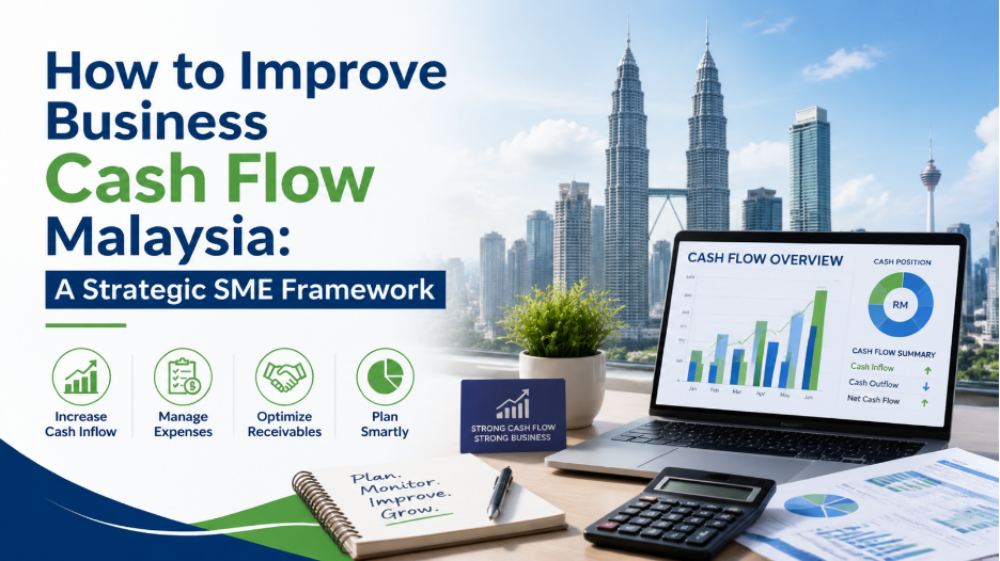
A healthy net profit margin means very little if your bank account is empty when payroll, supplier invoices, or corporate taxes are due. For small and medium-sized enterprises (SMEs) across Malaysia, managing liquidity has become increasingly complex as supply chains tighten and local economic demands shift. Sustaining operations requires moving past basic bookkeeping into active, strategic cash optimization.
Executive Blueprint: 4 Immediate Cash Flow Fixes
Before diving into deep operational frameworks, management teams can stabilize daily liquid capital by executing these four immediate steps derived from official SME Corporation Malaysia (SME Corp) fiscal guidelines:
• Enforce Strict Credit Matching: Ensure your payment timelines to vendors match or exceed the payment credit windows you extend to clients (e.g., do not pay raw material vendors in 30 days if your buyers take 60 days to settle).
• Ditch Bank-Balance Forecasting: Base operational spending on a rolling 13-week forward-looking cash projection rather than static, historical monthly bank balances.
• Mandate Pre-Credit Inquiries: Establish mandatory credit background checks and upfront deposits for all new high-volume contract buyers to protect inventory capital.
• Establish a Baseline Buffer: Secure an open business line of credit with your primary banking partners while your financials are strong, rather than waiting for a liquidity crunch to hit.
This article provides commercial decision-makers with an operational blueprint to bridge the gap between paper profitability and actual cash availability. You will learn how to identify hidden liquidity drains, optimize your working capital cycles, and structure your business to withstand sudden market shifts.
Understanding SME Cash Flow Management in Malaysia

At its core, business cash flow management malaysia refers to the strategic process of tracking, analyzing, and optimizing the net amount of cash receipts minus cash disbursements moving through a local enterprise. Unlike static balance-sheet accounting, active cash flow management focuses entirely on the timing of liquidity. It ensures that cash inflows are systematically accelerated while cash outflows are strategically managed.
Effective management requires a deep understanding of the working capital cycle, specifically the time it takes to convert raw inventory and labor into realized cash from customers. In the local commercial landscape, this involves monitoring key performance indicators (KPIs) like Days Sales Outstanding (DSO) and Days Payable Outstanding (DPO). Balancing these two metrics determines whether a business operates with a cash surplus or faces chronic, disruptive funding gaps.
Why Liquidity Optimization Matters for Malaysian Businesses
Operating an enterprise within Malaysia requires balancing specific local compliance mandates with regional supply chain realities. While a business might show robust growth on its income statement, an extended cash conversion cycle can halt operations entirely if raw material costs or import duties spike unexpectedly.
Based on our industry experience advising local enterprises, profitable companies fail far more often from a lack of immediate liquidity than from a lack of capital. Managing liquidity gaps is especially critical for B2B sectors, such as niche food and beverage manufacturing or industrial component suppliers, where standard payment terms frequently stretch between 60 to 90 days. Failing to align your collection cycles with operational overhead creates immediate friction with local vendors, impacts your credit rating with financial institutions, and stalls your capacity to take on larger customer contracts.
Key Trends and the Malaysian Market Landscape

The local regulatory landscape is undergoing structural changes that directly alter how businesses handle cash management. The progressive rollout of national digital initiatives, specifically the Inland Revenue Board’s (LHDN) e-invoicing mandate, is shifting compliance from a periodic accounting task to a real-time data requirement. This transition leaves minimal room for manual invoice adjustments or retroactive billing corrections.
Over the next 12 to 36 months, automated compliance systems will force organizations to upgrade their legacy enterprise resource planning (ERP) systems. Businesses that adapt quickly can leverage these standardized digital transaction footprints to gain clearer visibility into their cash forecasting. Conversely, companies relying on fragmented invoicing methods will likely face administrative processing bottlenecks that delay customer approvals and extend payment cycles.
Common Challenges and Cash Flow Pain Points
Managing day-to-day liquidity reveals several recurring operational bottlenecks that consistently drain cash reserves.
- Excessive Days Sales Outstanding (DSO): Customer accounts receivable regularly exceed agreed payment terms without automated triggers for collection or escalation.
- Mismatched Vendor and Customer Terms: Paying primary raw material suppliers within 30 days while granting major distribution clients extended 60- to 90-day credit windows.
- Capital Trapped in Slow-Moving Inventory: Holding excessive safety stock or unoptimized raw materials that tie up valuable cash on warehouse shelves.
- Inadequate Short-Term Forecasting: Relying entirely on historical bank statements rather than rolling 13-week forward-looking cash flow projections.
- Unexpected Statutory Compliance Adjustments: Lacking dedicated cash reserves for quarterly corporate tax installments or employee milestone contributions.
Practical Solutions to Improve Business Cash Flow Malaysia
To successfully improve business cash flow malaysia, management teams must transition from passive tracking to active operational intervention. Implementing structured financial frameworks allows you to unlock trapped capital from existing operations without relying solely on expensive external debt.
1. Optimize Your Accounts Receivable Processes
Accelerating collections is the fastest way to inject liquidity back into your business. Transition from manual tracking to systematic invoicing protocols immediately upon product delivery or project milestone completion.
- Offer early-settlement discounts: Provide modest incentives (e.g., 1% to 2% net 10) to corporate clients to encourage faster payouts.
- Enforce automated reminders: Setup structured, polite payment reminders starting 5 days before an invoice falls due.
- Establish strict credit-limit thresholds: Restrict credit terms for chronic late-paying accounts to reduce total bad debt exposure.
2. Restructure Working Capital and Expenses
Effective sme working capital management malaysia requires a systematic evaluation of your fixed and variable operational costs. Focus on reducing business expenses malaysia by eliminating redundancies rather than cutting into core production capabilities.
- Align payment windows: Renegotiate payment terms with core suppliers to better match your actual customer collection cycles.
- Consolidate procurement orders: Leverage bulk purchasing power or secure deferred payment windows with primary vendors.
- Audit administrative overhead: Review recurring overhead costs, software licensing, and underutilized logistics assets quarterly.
3. Utilize Targeted Business Financing Solutions
When operational adjustments are insufficient to cover temporary working capital gaps, structured financial tools can provide essential stability. Integrating alternative funding lines allows you to maintain momentum during high-growth periods.
- Deploy invoice factoring malaysia: Convert verified, outstanding B2B invoices into immediate liquidity rather than waiting out long credit cycles.
- Establish revolving credit lines: Secure flexible lines of credit with banking partners before a cash crunch occurs.
- Evaluate asset-backed financing: Utilize targeted business financing malaysia programs designed specifically for equipment modernization or facility upgrades.
For an in-depth breakdown of structured capital options tailored to local regulatory frameworks, review our comprehensive guide on maximizing operational efficiency via Our Page. If your organization requires direct support evaluating liquidity positions, our advisory team offers targeted asset restructuring through our Contact.
Future Outlook and Strategic Considerations
Navigating future economic cycles requires building financial agility directly into your organizational workflows. As localized inflation and global supply chains fluctuate, maintaining a rigid, backward-looking budget is no longer viable. Senior management must treat liquidity management as a core strategic capability rather than an administrative back-office task.
Over the coming years, corporate resilience will be defined by an organization’s readiness to digitize its treasury functions. Investing in cloud-integrated cash flow tools and training finance teams to run predictive scenario analyses will protect margins against sudden market shifts. Building this internal capability ensures your business remains highly fundable, compliant, and ready to capitalize on market opportunities.
Frequently Asked Questions (FAQ)
What is the most effective way to manage cash flow business malaysia?
The most effective approach is deploying a rolling 13-week cash flow forecast alongside tight accounts receivable protocols. This provides clear visibility into upcoming liquidity constraints, allowing management to adjust procurement schedules and accelerate customer collections before shortfalls impact daily operations.
How does invoice factoring help an SME in Malaysia?
Invoice factoring allows an enterprise to sell its unpaid B2B invoices to a financial institution at a slight discount. This instantly converts outstanding accounts receivable into immediate working capital, bypassing typical 60- or 90-day payment delays to fund immediate operational expenses.
Why do profitable Malaysian businesses experience cash flow failures?
Cash flow failures occur because profit margins on an income statement do not reflect immediate cash availability. A business may generate high sales volume, but if capital remains trapped in extended customer credit windows or unpaid inventory, it will lack the cash required to pay immediate liabilities.
How will LHDN e-invoicing affect business cash flow?
LHDN e-invoicing requires real-time digital validation of transactions, which minimizes manual billing errors and administrative disputes. While implementation requires initial system upgrades, it ultimately accelerates the validation cycle, leading to quicker invoice approvals and faster customer payments.
Strategic Next Steps
Optimizing your commercial cash flow is a continuous process that balances structured credit policies, lean operational cost structures, and agile financing tools. By reducing collection bottlenecks, aligning vendor terms, and utilizing modern digital forecasting frameworks, your business can build the financial resilience necessary to capture long-term market share.
Unlocking sustainable liquidity requires analyzing your operations from a practical, real-world perspective. To assess your current cash conversion cycle and explore structured working capital strategies tailored to your specific sector, connect with our corporate advisory team at our Contact Us Page to schedule an operational efficiency review.