
Lean manufacturing in the glove industry plays a direct role in business performance across Malaysia. Glove manufacturers face pressure from rising costs, strict quality demands and global competition. Lean manufacturing provides a structured way to improve efficiency, control quality and protect margins. This article outlines five practical ways that lean manufacturing in the glove industry enhances business performance, utilizing proven methods and real-world manufacturing practices.
Lean Manufacturing in the Malaysian Glove Industry Improves Quality, Consistency and Defect Control
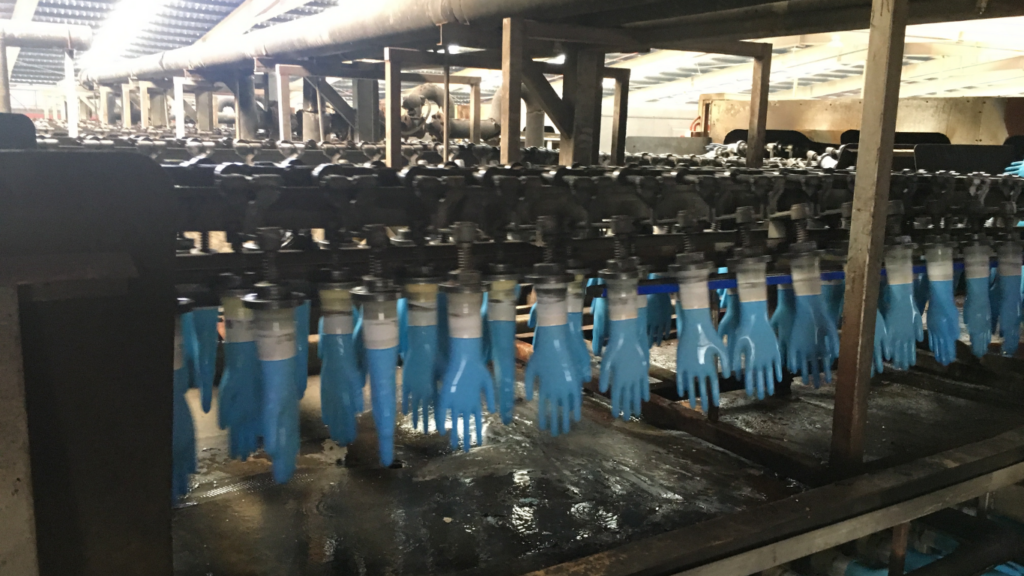
Lean manufacturing in the glove industry improves quality by controlling variation across production stages. Glove manufacturing involves compounding, dipping, leaching, drying, curing, inspection and packing. Each stage introduces risk for defects such as pinholes, weak tensile strength and uneven thickness. Lean manufacturing focuses on standard work, process stability and defect prevention at source.
Manufacturers apply Six Sigma DMAIC to define defect patterns, measure failure rates, analyze root causes, improve process parameters and control results. Studies from glove factories show defect reductions exceeding 30 percent after applying DMAIC on dipping temperature, oven speed and chemical concentration. Operators follow visual standards and real-time quality checks instead of relying on end-line inspection. This approach reduces rework, scrap and customer complaints. Quality stability improves business performance by protecting brand trust and lowering the cost per glove.
Reducing Lead Time in Malaysia’s Glove Industry Through Lean Manufacturing Practices
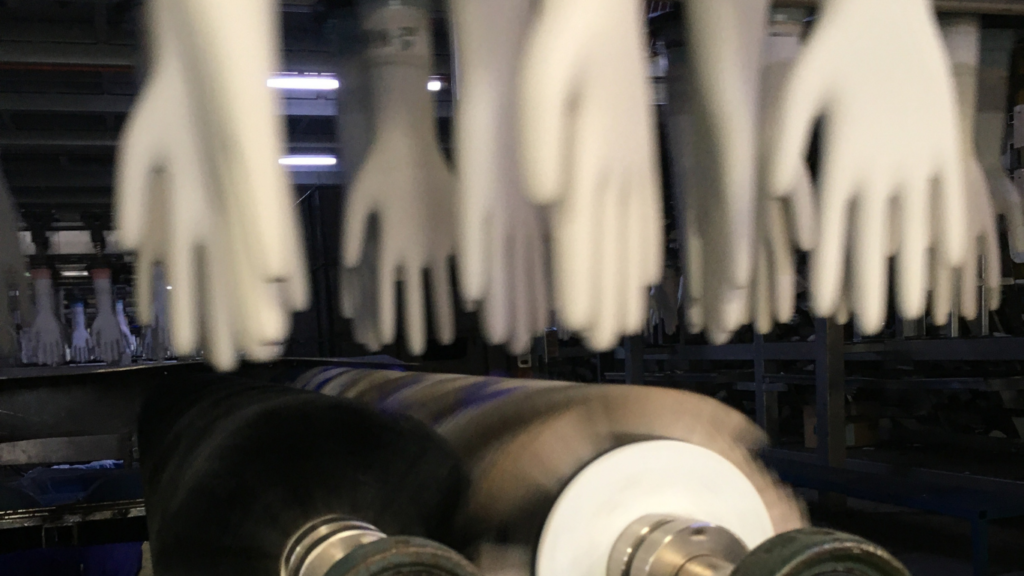
Lean manufacturing in the glove industry reduces lead time by removing waiting between processes. In many glove factories, materials sit idle between compounding, dipping, leaching and packing due to poor flow design. Lean manufacturing uses value stream mapping to visualize each step and identify delays that add no value. This method exposes excessive queue time, unbalanced workloads and inefficient layouts.
After mapping the current state, teams redesign the future state flow. They balance cycle times, align equipment speed and shorten transport distance. Some glove plants reduced lead time by over 40 percent after rearranging curing ovens closer to dipping lines. Faster flow improves responsiveness to customer orders and lowers work-in-process inventory. Reduced lead time improves business performance by freeing cash, increasing throughput and improving delivery reliability.
How Lean Manufacturing Boosts Productivity and Output in Malaysia’s Glove Industry
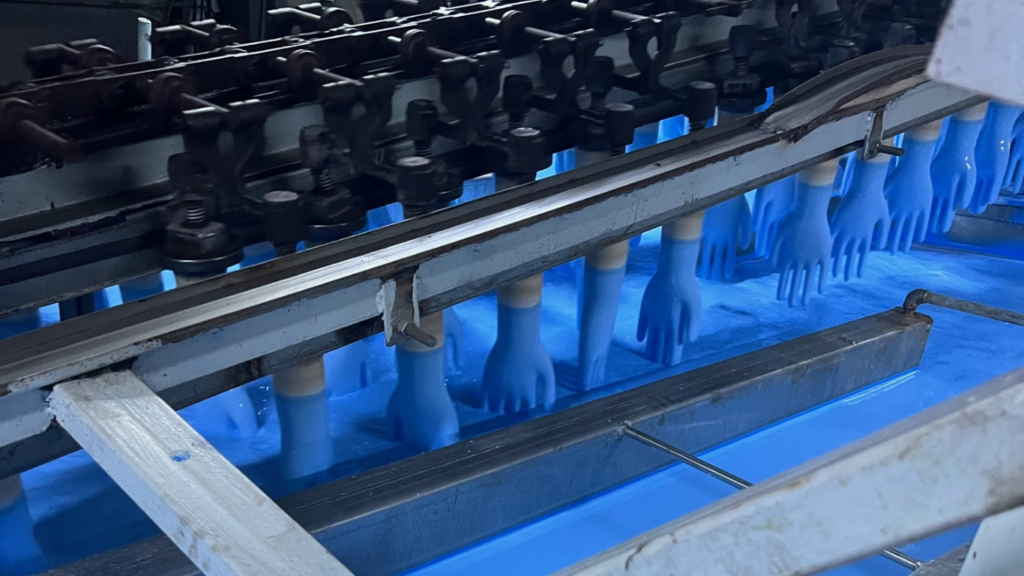
Lean manufacturing in the glove industry improves productivity by aligning manpower, machines and materials. Many glove factories struggle with uneven workloads across production lines. Operators wait for upstream processes or rush downstream steps, which creates fatigue and errors. Lean manufacturing applies takt time and line balancing to synchronize production with demand.
Factories that applied lean principles recorded productivity gains between 15 and 25 percent without adding labor or machines. Teams eliminated unnecessary motion, reduced manual handling and standardized operator tasks. Simple changes, such as organized tool placement and clear work instructions, reduced cycle time per rack. Higher productivity improves business performance by increasing output capacity while controlling operating costs. Manufacturers gain flexibility to scale production during demand surges.
How Lean Manufacturing in Malaysia’s Glove Industry Drives Cost Reduction and Operational Efficiency

Lean manufacturing in the glove industry strengthens cost control by attacking waste across operations. Waste appears as defects, excess inventory, overproduction, waiting, transport, motion and overprocessing. Glove manufacturing often carries high inventory due to safety stock policies and batch production habits. Lean manufacturing challenges these practices by using pull systems and better demand planning.
By reducing overproduction, manufacturers lower storage costs, energy usage and material degradation. Inventory reductions of 20 to 35 percent appear common after lean implementation. Cost-integrated value stream mapping links time losses directly to cost impact. Managers see waste in financial terms rather than abstract efficiency metrics. Strong cost visibility supports better business performance management decisions and protects profit margins in competitive markets.
Lean Manufacturing in the Malaysian Glove Industry Drives Automation, Industry 4.0 and Digital Growth

Lean manufacturing in the glove industry creates a stable base for automation and digital systems. Automation fails when processes remain unstable or poorly defined. Lean manufacturing standardizes workflows before introducing sensors, robotics and data platforms. This sequence improves automation return on investment and reduces implementation risk.
Many Malaysian glove manufacturers integrate lean manufacturing with Industry 4.0 initiatives. Automated dipping lines, real-time quality monitoring and predictive maintenance rely on consistent process control. Lean manufacturing ensures clean data and repeatable operations. Automation then reduces labor dependency and improves consistency. This alignment improves business performance by supporting scalable growth and cost efficiency.
Answering People’s Thoughts About Lean Manufacturing Improves Business Performance in the Glove Industry
What Is Lean Manufacturing in the Glove Industry?
Lean manufacturing in the glove industry focuses on eliminating waste, stabilizing processes and continuously improving quality from the customer’s perspective. It uses tools such as value stream mapping, 5S, Kaizen and Six Sigma to deliver safe, consistent and compliant gloves on time. With strong employee involvement at all levels, lean manufacturing improves operational efficiency, visibility and predictable business performance.
Who Is the Largest Glove Manufacturer in Malaysia?
Top Glove Corporation is Malaysia’s largest glove manufacturer and a global market leader. Through lean manufacturing, automation and continuous process improvement, the company maintains high-quality, high-volume production and strong international competitiveness.
What Is the Compounding Process in Glove Manufacturing?
Compounding prepares raw latex by mixing it with chemicals to control glove strength, elasticity and durability. Poor compounding causes defects and weak gloves. Lean manufacturing improves this process by standardizing formulations, controlling mixing parameters and reducing batch variation. Stable compounding enhances dipping and curing performance, increases yield and reduces scrap, supporting better business results.
Which Method Is Used to Sterilize Gloves?
Gloves are sterilized using gamma radiation or ethylene oxide, both meeting medical standards. Lean manufacturing enhances sterilization by minimizing contamination and reprocessing through clean, standardized workflows, leading to faster cycles, lower rejection rates and more reliable delivery.
Conclusion: Why Lean Manufacturing Is Key to Sustainable Growth in the Glove Industry Impact-Driven
Lean manufacturing in the glove industry delivers measurable improvements in business performance across Malaysia. Manufacturers reduce defects, shorten lead times, increase productivity, control costs and support automation growth. These outcomes rely on disciplined process control and a continuous improvement culture. Companies that apply lean manufacturing gain stability, scalability and competitiveness in global glove markets.