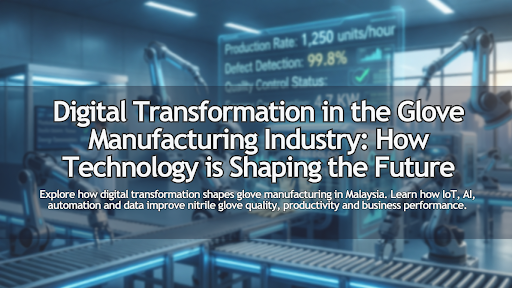


Glove manufacturing digitalisation changes the way factories produce gloves by shifting work from manual labour to automated and data-driven processes. This transition improves speed, consistency and cost control in a sector driven by rising global demand for nitrile gloves, latex gloves and industrial gloves. Many factories still depend on manual handling at key stages, which creates inconsistent quality and higher defect rates. Digitalisation creates better outcomes because decisions rely on information rather than assumptions.
Digitalisation also supports long-term planning. Factories measure cycle time, energy use, chemical balance and material flow with sensors and real time data systems. Managers understand problems faster because information updates without delays. This helps leadership reduce loss, improve order lead times and strengthen output. A modern glove manufacturer benefits from a stable production flow that meets global demand with fewer interruptions.
The Shift From Manual Glove Production to Digitalisation for a Better Experience

Manual glove production increases the risk of defects because repeating tasks by hand leads to variations. Workers must handle mould cleaning, chemical topping up and visual inspection under pressure. These tasks are sensitive to timing, temperature and chemical balance. Digitalisation removes these variations by regulating every stage of the process and delivering consistent outcomes.
Demand for nitrile gloves and industrial gloves continues to rise across medical, automotive and food service sectors. Manual lines struggle when demand changes suddenly. Digital systems respond faster because they adjust line speed, temperature or chemical dosing through central controls. Factories reduce waste because machines maintain accuracy throughout the entire cycle. This creates a more predictable output that supports a stable supply.
Manual processes also increase downtime because problems remain hidden until large volumes of gloves reach the inspection stage. Digitalisation solves this through alerts and sensor-driven monitoring. Workers respond quickly when problems appear. This reduces losses and improves production reliability. A digitalised glove line becomes easier to manage because each stage communicates important information in real time.
Digital Transformation as the Foundation of Modern Glove Manufacturing

Glove manufacturing digitalisation uses automation, robotics, artificial intelligence and IoT systems to build stable production lines. These technologies manage dipping, leaching, drying, curing and packing with precise control. Modern dipping lines can produce up to thousand more gloves per hour than older lines. This difference shows how automation changes capacity and productivity.
Automation manages tasks such as mould cleaning, chemical concentration adjustments and consistent dwell time. These tasks affect glove thickness, tensile strength and surface finish. When machines control these steps, defect rates fall and glove quality improves. The process becomes repeatable because machines follow one standard pattern without deviation.
Digital systems also store production data. Managers study chemical consumption, temperature changes and mechanical performance. This helps identify repetitive issues such as uneven drying or slow curing. Factories reduce energy costs because digitalisation controls heat more accurately. The entire operation becomes more efficient because each decision aligns with real time information.
Why Digital Transformation Improves Nitrile Glove Production?

Nitrile gloves require precise control of chemical composition and dipping sequence. Minor variations create thin spots, tears or incorrect weight. Manual processes struggle to maintain this consistency. Glove manufacturing digitalisation stabilises production because sensors track temperature, mould cleanliness and chemical pH throughout the cycle. Managers receive clear data that informs adjustments that protect quality.
Artificial intelligence strengthens quality control. AI visual inspection detects surface defects and thickness issues that human eyes miss. Many manufacturing plants report weight consistency improvements from around eighty percent to near full consistency after adopting AI-driven inspection. Fewer defective gloves enter packaging, which reduces waste and strengthens brand trust.
Digitalisation also reduces rejection rates because problems appear earlier. When a sensor detects changes in dipping viscosity or mould temperature, the system alerts workers immediately. This reduces large batch defects. It also improves worker efficiency because time is not wasted checking areas that function correctly. The result is a stable line with higher confidence in each glove batch.
Step-by-Step Digital Transformation Roadmap for Glove Production

• Step 1. Process assessment
A process assessment begins with a detailed study of mould cleaning, chemical mixing, dipping, curing, drying and packaging. Managers document cycle time, defect points and repetitive delays. This assessment reveals hidden waste, such as excessive mould downtime or long waiting periods between curing and stripping. With this baseline, factories understand which stages produce the most loss and where digitalisation will create the greatest improvements.
• Step 2. Build data infrastructure
A data infrastructure connects sensors to a central monitoring platform. Sensors track line speed, temperature, humidity, chemical balance, mould movement, energy consumption and vibration. This information forms a complete picture of the production flow. Data improves decision making because managers understand which parameters require correction before defects spread. It becomes easier to predict material needs and plan production schedules.
• Step 3. Automate high impact areas
Automation starts with the stages that produce the most waste. Chemical dosing, mould cleaning, coagulant dipping and drying control benefit strongly from automation because small variations in these steps create defects. Automation ensures stable time and temperature control. This improves glove consistency because machines perform tasks without fatigue or deviation. Automating these areas protects product quality and raises total output.
• Step 4. Introduce AI quality control
AI inspection systems scan each glove for small tears, thickness inconsistencies and surface issues. These systems check thousands of gloves faster than human inspectors. AI also stores defect patterns so managers know where problems begin. This improves root cause analysis and reduces repeat issues. AI inspection protects customers because defective gloves leave the line before reaching packing.
• Step 5. Predictive maintenance
Predictive maintenance uses vibration sensors, motor heat readings and cycle load data to forecast failures. This system alerts workers before a major breakdown occurs. Predictive maintenance reduces downtime and protects expensive production equipment. It also improves safety by preventing mechanical problems from escalating. This stabilises production and prevents large disruptions.
• Step 6. Digital training for workers
Digitalisation changes many workers’ responsibilities. Workers shift from manual tasks to monitoring dashboards, interpreting alerts and supporting automated systems. Digital training programs teach workers how to interact with data and respond to sensor alerts. This increases productivity because workers develop stronger technical skills and maintain the new equipment more effectively.
• Step 7. Business performance management integration
Once production becomes digital, factories connect operational data to business reporting. Managers track cost per glove, chemical consumption, cycle time, energy use and defect rate with precision. This information improves forecasting, purchasing decisions and long-term planning. Digitalisation also supports investor confidence because performance data becomes clear and measurable.
Digital Transformation Technologies Used in Glove Manufacturing

Automation controls dipping processes, mould movement, curing conditions and packaging systems. Robotics move gloves between stations without errors. Artificial intelligence monitors glove quality at high speed and identifies defects before packaging. IoT devices collect real time data from machines and dipping tanks. Predictive maintenance systems prevent breakdowns by monitoring machine health. Remote monitoring systems provide alerts even when managers are off site. These technologies build a system that performs better each day because information flows continuously.
Benefits of Digital Transformation for Nitrile Gloves and Latex Gloves

Digitalised systems raise output because machines maintain a consistent speed without fatigue. Quality improves because inspection and dipping controls eliminate variations that increase defect rates. Factories reduce labour dependency because automated systems complete tasks that previously required large teams in manual operations. Energy use and water consumption fall because digitalisation improves curing and leaching control. Sustainability goals become easier to meet because waste decreases and resources remain under tight control.
Common Digital Transformation Mistakes in Glove Manufacturing Digitalisation and How to Avoid Them

One mistake is failing to collect baseline data before automation. This makes it hard to measure progress. Another mistake is implementing digital tools without preparing workers. Skilled workers must understand data to support the new systems. Poor integration between sensors and software also slows progress. Factories must test interoperability before full deployment. A final mistake is ignoring predictive maintenance. Without predictive tools, digital lines still face unplanned breakdowns that disrupt production.
Future of Digital Transformation in Glove Manufacturing

Digitalisation will continue to expand through stronger AI systems that adjust production settings in real time. Digital twins will simulate entire production lines to test changes without stopping work. Remote operations centres will monitor multiple factories from one location. Water recycling and energy optimisation systems will support sustainability and lower operational costs. Glove manufacturing will continue to shift toward more precise, data driven operations.
Frequently Asked Questions
- What is digital transformation in glove manufacturing
Digital transformation in glove manufacturing refers to upgrading manual glove production into automated and data driven systems. It uses sensors, robotics, automation, AI inspection and predictive technology to improve speed, quality, and cost efficiency. - How does automation improve glove production?
Automation increases production speed by controlling dipping, curing, and finishing stages with precision. It reduces labour dependency and lowers the number of defects caused by manual errors. - Why is data important in digital glove manufacturing
Data helps managers understand cycle times, defect patterns, chemical usage, and machine performance. These insights support better decision making and higher production stability. - How does AI help with glove quality control?
AI visual systems detect surface defects, thickness variations, and micro tears in real time. This reduces faulty gloves and raises quality consistency for nitrile gloves and latex gloves.
Closing View on Glove Manufacturing Digitalisation
Glove manufacturing digitalisation produces stronger outcomes for factories that want higher output, lower defects and stable operations. The process moves production from manual methods to automated and data driven systems. This shift creates more predictable results and reduces operating costs. A structured plan and consistent training help manufacturers reach stronger performance while preparing for future demand growth.